

Thank you all for coming out today to support the Anika
Foundation.
Since a similar function last year the Foundation has continued to build up its capital,
and this year will be making its first grants by way of scholarships, called
the Anika Foundation Depression Awareness Scholarships, as a part of the NSW Premier’s
Teacher Scholarship Program. These will enable teachers and counsellors in
our schools to travel, study responses to adolescent depression in other countries
and return to NSW to raise awareness and improve responsiveness to depression
among school students. Your interest in being here today will help us to build
further over the coming year, when we hope to expand this same sort of scholarship
to other Australian
states.
In time, funding permitting, we would also like to establish a PhD-level research
scholarship in the field of adolescent depression.
Thank you also to Macquarie Bank for providing the venue and food for today’s
event, and to the Australian Business Economists for their logistical and advertising
support.
Ten years ago this month, the Thai baht was allowed to float. It promptly fell very
sharply. There were danger signs before then, but if we were looking for one
event that marked the start of the Asian financial crisis, this would be it.
By the end of the year, the crisis had engulfed Thailand, Indonesia, Korea,
Malaysia and the Philippines, countries with a combined population of around
400 million. It had very pronounced effects on neighbouring countries
like Singapore, serious financial contagion effects on Hong Kong, and had a
discernible impact on the global economy.
More fundamentally, perhaps, the crisis brought to an end a period of extraordinary
economic growth in Asia, and seriously deflated optimism about future growth.
It has proven very difficult to recapture that sense of optimism. While that
earlier ebullience may, of course, have been overdone, the scars of the crisis
remain fresh in some respects even a decade later.
Graph 1
With the passage of time it is of some value to re-visit the crisis, to ask what
has been learned, what steps have been taken to strengthen national, regional
and international arrangements against a recurrence, and what remains to be
done. That is the task that I shall begin today, though it is probably too
big a task to finish in one session.
What happened?
I start with the question: what happened?
There are many detailed treatments available elsewhere of what occurred, and I cannot
do full justice to the literature or to the events themselves, which were fairly
complex.
We must be mindful, too, that ‘Asia’ is not some homogenous mass,
but a group of countries and economies that have considerable variety in their
historical development and their approach to some economic policies. Nonetheless,
I have to generalise for the sake of brevity.
Asian economies grew rapidly through the mid 1990s. Average rates of GDP growth were
between 7 and 10 per cent in most cases over the decade up to
1996. Rates of investment were high, and current account positions in several
cases showed substantial deficits. Put another, and more illuminating, way,
there was substantial capital inflow. In the case of Thailand, capital inflow
amounted to about 10 per cent of GDP per year between 1990 and 1996, though
that was at the high end of the range in the region. In Indonesia’s case
the corresponding figure was 3½ per cent. From an Australian viewpoint,
that does not seem all that big, actually, but it had the Indonesian authorities
concerned at the time.
| 1987–1996 | 1997–1999 | 2000–2006 | |
|---|---|---|---|
| Hong Kong | 5.2 | −0.8 | 4.7 |
| Indonesia | 7.1 | −6.4 | 4.9 |
| Korea | 8.1 | 1.0 | 4.6 |
| Malaysia | 9.5 | −0.8 | 4.7 |
| Philippines | 3.6 | 1.4 | 4.6 |
| Singapore | 9.2 | 2.8 | 4.6 |
| Taiwan | 7.2 | 5.1 | 3.3 |
| Thailand | 9.5 | −3.3 | 5.1 |
| East Asia* | 7.6 | 0.0 | 4.5 |
|
*Excluding China and Japan
Source: IMF, CEIC, RBA
|
|||
Capital markets in the region were underdeveloped, so the capital inflow tended to
be intermediated through the banking sector. Exchange rates were heavily managed,
and the counterpart of the inflow was a large build-up in money and credit
in the domestic financial sectors, an associated inflation of asset values
and some rise in prices for goods and services.
Foreign currency risks associated with these flows were large, and were being incurred
by domestic entities rather than being shared around the global markets. In
many instances, neither borrowers nor their bankers were managing these risks
at all well, in part due to weak risk-management capacities and ineffective
supervision and, in part, no doubt, because the exchange rate regimes were
assumed – wrongly as it turned out – to be robust. Foreign
counterparties also seemed insufficiently attuned to the likely difficulties
that could be experienced by the Asian borrowers and financial institutions,
and their own limited ability to exit collectively what were quite small markets
in the event that things went wrong.
Pressures on the Thai currency began late in 1996, with early signs of some problems
in local lenders coinciding with a rise in the effective exchange rates (and
hence a decline in competitiveness) of some Asian countries owing to the rise
in the US dollar and a downturn in the semiconductor
market, which had been an important source of growth. For a time the Thai authorities
were able to resist these pressures but they had to give up by mid 1997, as
foreign exchange reserves were exhausted.
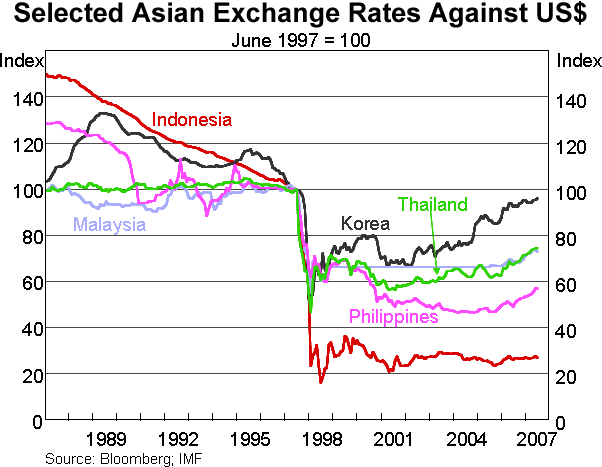
The baht was floated on 2 July. It fell by 13½ per cent that day
and ended the month 23 per cent lower. Intense pressure quickly flowed
to currencies of neighbouring countries. A period of stability following the
announcement of the support program for Thailand in early August was short
lived and by early October the currencies of Thailand, Malaysia, the Philippines
and Indonesia were again under intense pressure. Attention then shifted to
the economies of north Asia, which up until then had been only lightly affected.
There was tremendous pressure on the Hong Kong dollar peg, where overnight
interest rates soared and the share market slumped. As corporate and banking
problems intensified in Korea, foreign lenders cut back credit lines, and in
November Korea approached the IMF for assistance in meeting foreign currency
obligations. Political and economic uncertainty in Indonesia became extreme
in the first half of 1998, and the rupiah lost 85 per cent of its value.
Even today, the rupiah trades at a 75 per cent discount to its pre-crisis
level.
In recent years, we have lived in an environment of unusually subdued volatility
in international financial markets, so we tend to forget just how discontinuous
price movements can sometimes be. But the uncertainty and financial skittishness
that encompassed the global economy in 1998 were pervasive.
It was not confined to emerging markets either. By August 1998, we had the Russian
default, followed by the LTCM crisis in September. Around that time, the US dollar/yen
exchange rate moved 30 big figures in three months, and at one point nearly
15 per cent in one day. Now that’s volatility! One observer later described the international
financial system in the late 1990s as having endured perhaps its ‘greatest
stress in the post-war
period’.
In Asia, as the financial market prices adjusted, some of the underlying vulnerabilities
came more clearly into focus. The unhedged foreign currency positions meant
that the authorities in the crisis countries faced a huge dilemma: as the exchange
rate fell, the borrowers or their bankers, or both, went under water owing
to the valuation changes on the debts. But raising interest rates to support
the currency damaged capacity to repay as well.
It was this financial dimension that made the Asian crisis so costly. And costly
it certainly was. Per capita real GDP fell by about 9 per cent in east
Asia excluding China and Japan. The fall in Indonesia was 15 per cent.
On the best available figures, non-performing loans (NPLs) reached nearly half
of all loans in Indonesian and Thai banks, and NPL ratios reached double-digits
in several other countries in the
region.
The process of sorting out banking problems of this magnitude required, as it usually
does, extensive public funding. The net fiscal costs of the banking crises
are estimated to have been over 20 per cent of a year’s GDP in Korea,
35 per cent in Thailand and about 40 per cent in
Indonesia.
We sometimes read that Asia quickly recovered. I am not so sure. In due course, recovery
in Asia did take hold, but it was very slow in some cases. The pre-crisis peak
in real per capita GDP was regained within two or three years in Korea, the
Philippines, Singapore and Hong Kong. But that achievement took five years
in Thailand, six years in Malaysia and seven years in Indonesia.
To put that in perspective, after the 1982 recession in the United States,
real per capita GDP took about two years to regain its previous peak.
In Australia after the 1990-91 recession, it took about three years. As
I recall, those episodes were widely seen as serious.
| Change post-crisis* | Years to recover | |
|---|---|---|
| Per cent | ||
| Hong Kong | −6.4 | 3 |
| Indonesia | −15.0 | 7 |
| Korea | −7.5 | 2 |
| Malaysia | −9.5 | 6 |
| Philippines | −2.7 | 3 |
| Singapore | −4.6 | 2 |
| Thailand | −11.6 | 5 |
| East Asia** | −8.8 | 3 |
| Memo items: | ||
| United States (1981/82)^ | −3.8 | 2 |
| Australia (1990/91) | −3.8 | 3 |
|
Source: IMF, CEIC, Thomson Financial, ABS, RBA
|
||
Even accepting that the pre-crisis situation was unsustainable, it is clear that
the cost of the Asian crisis was enormous, and the recovery slow. In fact,
the average rate of per capita GDP growth in east Asia post-crisis was a little
more than half what had been seen in the decade up to 1996.
What did we learn?
We learned a good deal about the nature of crises from these events. This was a different
sort of crisis from the ones that had often been seen in earlier periods. It
was not a standard example of a currency crisis resulting from lax macroeconomic
policies, in which large budget deficits (often funded from abroad), easy money,
high inflation and so on lead to a loss of confidence in the policy regime
and capital flight. In those cases, the standard remedy is mainly macroeconomic
tightening to restore discipline and investor
confidence.
In Asia, by contrast, fiscal and monetary policies had always been reasonably conservative.
Inflation rates were low by developing country standards, budgets were reasonably
controlled in most cases, and government debt levels were generally not
excessive.
Graph 2
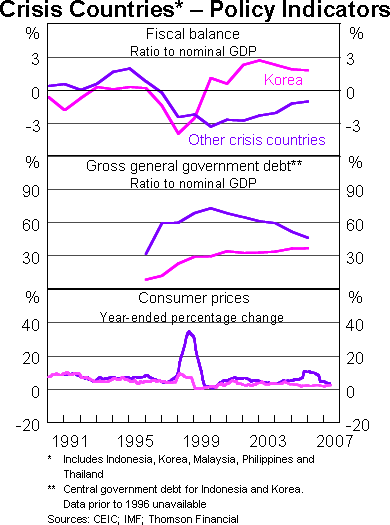
At its heart, the Asian crisis was a banking crisis brought on by banks and their customers taking on too
much foreign currency risk. No doubt macroeconomic policies were not always
perfect, but the real problems were in the financial structure more than the
macroeconomic settings. This is now well understood, but it was not fully appreciated
at first by many outside observers, even though some Australian commentators,
to their very great credit, understood it very
quickly.
A period of learning about how this type of crisis was likely to unfold and
what needed to be done was inevitable, but it delayed recovery. Macroeconomic
tightening was always going to be some part of the response, but far from sufficient
on its own, and if carried too far would be counterproductive. General structural
reform of the economy’s supply side, moreover, however desirable from the
point of view of raising long-run growth rates, was always likely to play little
role in the immediate recovery from a crisis of this nature, in which demand
collapsed. In fact, recovery depended on addressing the financial burden of
the debts as directly and quickly as possible.
The biggest problem that the countries of Asia had was that they had not developed
the financial infrastructure needed to provide resilience to swings in mood
before becoming more open to flows of international capital. In drawing lessons,
much discussion focused on the difficulty of maintaining relatively inflexible
exchange rates in an environment of relatively open capital accounts. While
the early tendency to conclude that only corner solutions – hard
pegs or unfettered floating – were viable has softened over time,
I think most observers would say that a degree of flexibility is needed, in
most cases, to build resilience to swings in capital flows.
But it was not just exchange rates that were the problem. The capacity of financial
institutions and corporations to manage risk, and of the supervisors to enforce
better management, were far too weak. The markets required to manage such risks
– to hedge foreign currency exposures, for example –
were small or non-existent. More generally, capital markets were underdeveloped,
especially local-currency denominated ones. Hence, not only were the risks
concentrated in the banking system, but when the banks could no longer extend
credit there was no other channel to make up the difference.
As the countries concerned and the international community came to grasp these lessons,
the nature of the debate changed. We began to hear much more discussion about
‘capital account’ crises, and the proposed responses became much
more nuanced. Hitherto seldom-disputed notions about the optimality of rapid
opening up to international capital flows became more widely questioned. Capital
controls – anathema in the world of the early 1990s –
became respectable under certain circumstances. Much more focus was placed
on developing bank supervision, and also such supporting frameworks as bankruptcy
laws, corporate governance standards and so on. In international circles, there
was considerable discussion about the need for some sort of international counterpart
to domestic commercial bankruptcy procedures – ‘standstills’.
The countries most affected by the crisis drew their own particular conclusions too.
One was that while the international financial institutions might come to their
assistance, there would be a lot of strings attached, and the assistance might
prove to be neither timely nor sufficient. From this judgement, whether it
was correct or not, about the international mutual insurance arrangements embodied
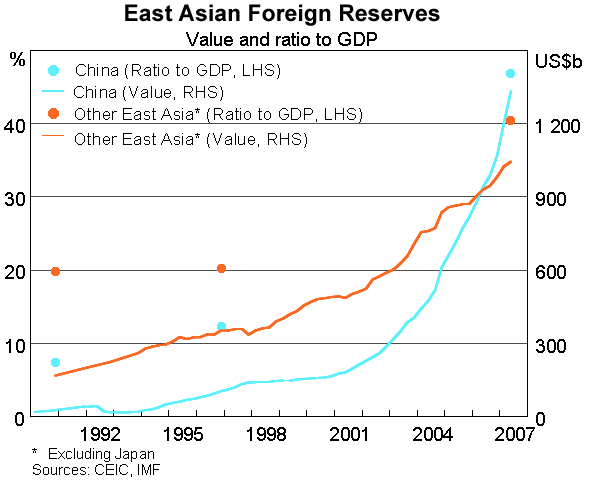
in the IMF, two things followed. First, the countries of Asia decided to self-insure,
by building larger foreign currency reserves. In the face of speculative attacks
in future they would be better armed. Ironically, the IMF itself encouraged
this reserve build-up initially.
Graph 3
Second, the countries of the region re-doubled their efforts towards building regional-support
arrangements. There had been much discussion of this prior to the crisis, and
some largely symbolic arrangements had even been put in place. But after the
crisis, there was much more activity in this space.
What then has been achieved in the area of strengthening the countries concerned
and the international system since the crisis?
What has been achieved in Asia since the crisis?
At the risk of over-generalising, several common themes emerge at the national level.
First, as one would expect, there has been an even greater emphasis first on
pursuit of sound macroeconomic policies. Of some note is that in several countries
monetary policy frameworks have moved towards inflation targeting. This is
a natural progression when the exchange rate is no longer available as an anchor
for policy. Thus far this framework has been operated with a fair degree of
success. Fiscal positions in most countries have been improved, after a period
post- crisis when some countries showed large deficits.
Countries in the region have also done a lot of work aimed at making their financial
intermediaries stronger. The frameworks for dealing with impaired assets in
the immediate aftermath of the crisis have, together with the economic recovery,
resulted in a gradual improvement in the shape of balance sheets of the core
institutions, though more progress is needed yet in some countries. One World
Bank report puts the average ratio of NPLs to total loans in the five initial
crisis economies at 6 per cent in 2006 – still a high figure
by industrial country standards, but down from close to 30 per cent in
1998.
Foreign participation in local financial systems has increased in several countries,
which brings both capital and
expertise.
| At peak* | 2006 | |
|---|---|---|
| Indonesia | 48.6 (1998) | 6.1 |
| Korea | 13.6 (1999) | 0.9 |
| Malaysia | 11.5 (2001) | 4.8 |
| Philippines | 17.3 (2001) | 6.0 |
| Thailand | 45.0 (1998) | 8.1 |
|
*Year of peak in brackets
Source: World Bank
|
||
Emphasis has been placed on beefing up bank supervision and fostering a stronger
culture of risk management in the private sector. This is an area, however,
where rapid progress is very difficult, and several countries still have difficulty
meeting the relevant international standards. Developing and maintaining a
strong supervisory apparatus is a challenge in any country at any time, no
less so in the Asian region. Countries have also pursued stronger requirements
for disclosure, better accounting and auditing standards and so on. That said,
progress towards improving the broader regulatory and governance arrangements
that condition the ‘investment environment’ has, in the view of
at least some commentators, been mixed, at
best.
A good deal of work has also been done, particularly of a co-operative nature between
countries, aimed at fostering deeper, more resilient capital markets. The Asian
Bond Funds, initiated by the regional central banks, established cross-border
mutual-fund type structures allowing regional investors to hold obligations
issued in local currency by regional governments and quasi-government authorities.
The ASEAN+3 group has encouraged the issuance of local-currency debt by the
multilateral institutions. The development of securitisation and credit guarantee
markets in the Asian region has been promoted through a number of regional
fora, and securitisation in east Asia has grown quite rapidly since 1999, particularly
in Korea, Hong Kong and Malaysia. These sorts of initiatives typically involve
trying to remove the various small impediments that individual countries have
(sometimes unintentionally) put in the way of investors, and progress towards
the mutual recognition of regulatory frameworks in differing countries. These
have been very useful examples of practical co-operation – and of
how much work is involved in giving practical effect to general ideas agreed
to so easily in international meetings.
More ambitious ideas for mutual support have also been pursued, of which the Chiang Mai
Initiative (CMI) is probably the most concrete. CMI provides for the countries
in the ASEAN+3 group a series of bilateral swap lines, with the amounts committed
being increased
progressively.
Recently, an in-principle agreement was reached to make the lines multilateral rather
than bilateral, which would presumably make for more efficient activation in
a crisis.
As a result of these developments, I imagine that today few countries in Asia would,
if they got into trouble, consider an early approach to the international financial
institutions for assistance. But while the regional initiatives are all useful,
they remain to be tested under less benign conditions in the global financial
system. In fact, it is open to doubt whether they would necessarily prove sufficient
as a defence mechanism, were really big changes in sentiment about the region
to occur in international markets the way they did in 1997-98. If most countries
in the region were under pressure at the same time, there would surely be questions
as to whether regional counterparties could meet all the commitments for support.
In any case, few financial crises are confined to one region: even those that start
with a regional focus have a habit of spilling over quite quickly, as events
after the Asian crisis demonstrated. So while everyone has an interest in regional
crises being effectively dealt with at the regional level, we surely still
need global mechanisms for dealing with crises, and preventing them as far
as possible. That prompts the obvious question: what has been done since the
Asian crisis to improve the global arrangements?
What has been done internationally since the crisis?
A good deal of effort has gone into crisis prevention. There has been a step-up in
national and regional-level surveillance by the international official bodies,
and an emphasis on more timely and accurate data being made available by governments.
A stronger focus on financial sector soundness is another key element, with
a number of countries undergoing Financial Sector Assessment Programs, in conjunction
with the IMF.
These and other efforts represent serious attempts to use what was learned from the
Asian and other crises to reduce susceptibility, or at least to get an early
warning of regional level problems, in future. But as useful as these things
are, no- one could say that they will definitely prevent future crises. Hence,
crisis management arrangements have still been given attention.
One of the key elements is calming behaviour in capital markets once a crisis occurs.
The private sector has contributed with a code of conduct, known as the Principles
for Stable Capital Flows and Fair Debt Restructuring in Emerging Markets,
which provides a flexible framework for co-operative discussion and action
between private-sector creditors and emerging market sovereign debtors. A complementary
initiative was the introduction of Collective Action Clauses in emerging market
bond contracts. This is intended to lessen the problem of getting collective
action when a debtor needs to reschedule, by preventing minority hold-outs
from derailing the rescheduling. The use of such clauses is now
widespread.,
A more far-reaching idea is that of stand-still provisions. This is, conceptually,
the international equivalent to bankruptcy proceedings, where, once a creditor
cannot repay in full, there is a temporary cessation of all payments while
an orderly process works out how much creditors can collectively expect to
receive, rather than a disorderly and ultimately very costly rush to the exits.
This idea found concrete expression in the proposed Sovereign Debt Restructuring
Mechanism discussed at the IMF, but did not attract sufficient support from
major countries and has not gone
forward.
There has been some evolution in the architecture of international groupings over
time. The formation of the G-20 had its genesis around the time of the Asian
crisis. Its membership is more representative of the global economy and financial
system of the 21st century, as opposed to the mid-20th
century, and it has become more prominent over recent years. In parallel, the
G10 seems to be diminishing in importance. With no crises of any magnitude
in the past few years, the G-20 has turned its attention to other matters,
including issues on the structural side. We should hope, though, that the G-20
will retain a capacity to talk frankly about urgent issues in the highly informal
but effective way it did at first, should some new crisis erupt. The Financial
Stability Forum (FSF) was another creation of the more crisis-prone era, and
is a useful body for getting key officials together regularly to identify potential
threats to global stability.
But while these architectural changes are helpful, the G-20 remains a work in progress,
and the FSF is a consultative group, not a decision-making one. The reality
is that if there is to be collective international action in the face of a
crisis, international financial institutions, with formal mandates and balance
sheets, will remain very important. Focus on adapting the IMF to 21st century needs has intensified in recent years. Questions
of governance have been to the fore, in particular relating to representation
and voting power for emerging market countries. A small but significant step
was made last September with increased quota allocated to four important emerging
market countries which had been under-represented. The more laborious work
of getting agreement on longer-run and more far-reaching changes is now under
way and has some distance to travel.
But it is critically important too that resolution of the questions about the IMF’s
mandate – what we want it to do – accompanies the governance
reform. It will not be sufficient for the emerging world simply to expect more
say in how the international financial institutions are run, without being
part of a clearer shared understanding of what the institutions are seeking
to achieve. That is a topic for another speech, but suffice it to say that
constructive engagement by the emerging world, and especially Asia, in finding
an agreement on mandate will be a key prerequisite for genuine progress.
Asia’s future in the global financial system
After all this, then, how would we sum up the way things have changed since July 1997?
Is Asia, or the world, less vulnerable to a crisis than it was then, or not?
Were we to ask policy-makers in the countries concerned, I am pretty sure they would
say they remain acutely conscious of theirs being small countries in a world
of large capital flows, with the attendant possibility of being overwhelmed
by those flows – in both directions. Suspicion in the region of
some of the larger players in international markets remains strong, as does
the desire for regional co-operation in handling the financial ebbs and flows.
That said, vulnerability to a 1997-style crisis must have been reduced. The build-up
in reserves means that speculative outflows could now be handled more effectively.
Furthermore, the fact that most exchange rates have some more flexibility now,
even if they do not float completely freely, also means that the authorities
would be in a much stronger position because they can allow that price to bear
some of the adjustment before they intervene. The various regional initiatives
have contributed to development of capital markets and stronger mutual-support
arrangements. The former still has some way to go and the latter have not been
tested, but certainly progress has been made.
But maybe the question of whether Asia could withstand 1997 better if it occurred
again is not the right question. A future crisis could be of quite a different
nature. It is at least as likely to be truly global as to be regional, and
just as likely to originate in the developed world as in the emerging world.
A generalised re-assessment of risk would no doubt test the resilience of the
countries of Asia, along with everywhere else. That being the case, it is in
Asia’s interest that international efforts to manage risks more effectively
on a global basis be continued. It would also be important therefore for Asia
to be sure that Asian regionalism does not become inward-looking. Asia has
mostly benefited from engagement with the global economy, and that will continue
to be so.
Another question is whether some aspects of the approaches being taken to avoid 1997
recurring are themselves starting to become a problem. In particular, the build-up
in reserves has gone a long way past what seems sufficient for self-insurance
purposes, and has surely complicated monetary policy in some cases, not least
in China. The associated capital flows are big enough, moreover, to have a
significant effect on global markets and potentially to rebound onto the Asian
region. The rising size of sovereign wealth funds, and what risk profile they
will have, is also a question that is likely to be important to countries receiving
the capital flows.
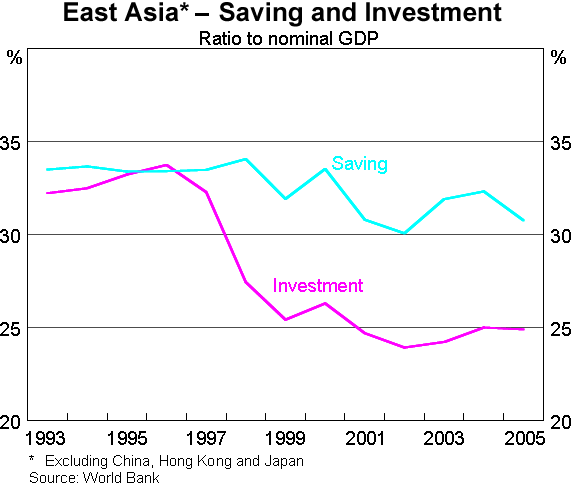
For the Asian crisis countries, we should ask: is it optimal for so much saving to
be funding investment in the developed world when the social return to investment
at home surely ought to be higher? While investment prior to the crisis may
have been unsustainably high, in some of these countries it is now arguably
too
low.
Given that many changes over the past decade have been implemented to try and
improve the stability of the region, do local investors still perceive the
risks to be so great that they are unwilling to invest in their home countries?
If so, why? Does that point to the need for further efforts at improving governance
frameworks and regulatory environments, deepening capital markets and so on?
Graph 4
The reason to address these issues has something to do with avoiding crises in future,
but it has more to do with improving Asian living standards. To see how relevant
that is, moreover, we need only look at the sorts of per capita growth rates
post-crisis compared with the decade leading up to the crisis. They are much
lower. The growth is not as easy to get as it once appeared, which puts the
focus squarely back onto policy frameworks.
Conclusion
The Asian crisis was an extremely costly event for the countries concerned. The crisis
is now a decade in the past, but those costs continue to be felt today in a
number of countries.
The crisis dramatically changed thinking in Asia, and around the world, about the
nature of economic and financial crises, the policies appropriate to dealing
with them, and the role of the various regional and global bodies charged with
fostering economic and financial stability. It is important that the passage
of time, and the apparently benign environment we have recently enjoyed, do
not prevent us from pressing on with the as yet uncompleted regional and global
efforts to develop more resilience. Were we to slacken efforts there, we would
surely come to regret it.