


Australians could soon face higher prices for everyday goods, food, fuel and overseas holidays after the Australian dollar plunged to its lowest level in 10 months.
On Monday, the Australian dollar fell to US67.4 cents, slipping below US68 cents for the first time since January, when it reached a 12-month low.
It means every Australian dollar buys less overseas, making imported goods more expensive and leaving holidaymakers with less spending money when travelling abroad.
The falling currency could also add to inflationary pressures, potentially making it harder for the Reserve Bank to bring interest rates down.
Economists warn that if the dollar remains weak, the higher cost of imports could gradually flow through to supermarket shelves, petrol stations and retail stores.
‘It’s usually a little inflationary because what it means is the cost of imported goods goes up,’ MacroBusiness chief economist Leith van Onselen told the Daily Mail.
‘For anything that comes off a ship, which comes from overseas, the lower-valued Australian dollar will purchase less of it, which means that it can be inflationary on tradable goods from overseas.’
Van Onselen said Australians could feel the effects at the petrol pump because most of the nation’s fuel is imported.

Australians could soon pay more for everyday goods and fuel after the Australian dollar fell sharply over the past 11 months. Pictured, a petrol station in Sydney
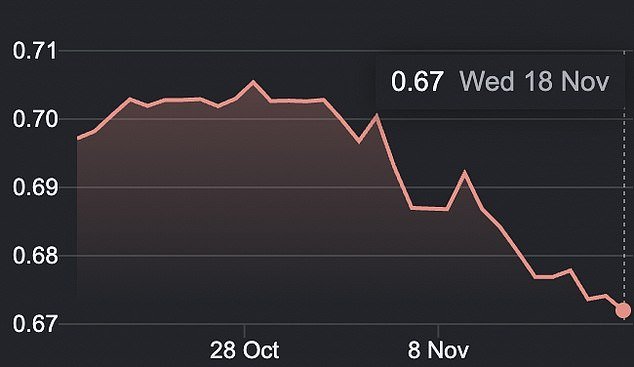
The AUD/USD has fallen to a ten-month low. A chart shows the trend over the past 30 days
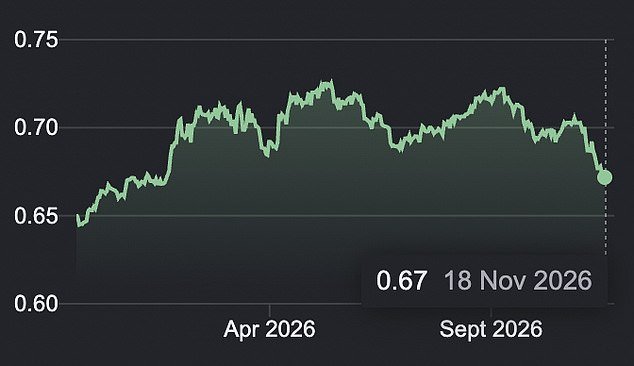
The chart shows how the Australian dollar has performed against the US dollar over the past 12 months.
‘It could also put slight upward pressure on petrol prices or diesel prices at the pump because the Australian dollar will buy less of those things,’ he said.
‘Most of Australia’s petroleum that you use to fill up your car is sourced from offshore and most of the refined petrol and diesel comes from overseas as well.’
The impact might not be felt immediately, Van Onselen added, but if the currency remains low, ‘a lower dollar would make, anything that comes from overseas slightly more expensive’.
Van Onselen said the drop would also make overseas travel more expensive because of the weaker exchange rate.
Asked why the Australian dollar had fallen, Van Onselen said higher interest rates would normally make the currency stronger.
However, falling prices for Australia’s major exports, particularly iron ore, were helping push the dollar down.
‘Usually when Australia’s interest rates are higher than other countries, as they are at the moment, it puts upper pressure on the dollar, which is not happening at the moment,’ he said.
‘But also, the Australian dollar historically has been tied somewhat to commodity prices.

While the Australian dollar regularly rises and falls, economist Leith van Onselen warns a lower value against the US dollar will make anything imported from overseas more expensive
‘So, iron ore prices, for example, which is our main commodity export, have been falling, and that’s putting some downward pressure on the Australian dollar.’
He said the dollar had risen earlier in the year but was now losing those gains.
‘The value of the dollar moves up and down. It’s volatile and, earlier in the year, the Australian dollar had quite a bit of appreciation, and now it’s sort of giving that back.’
NAB’s senior FX strategist Rodrigo Catril said the dollar could have even further to fall.
‘Well, it’s kind of two forces going, unfortunately, against the Aussie at the moment.
‘From an overseas perspective, as you mentioned, the Fed is signalling that they’re not yet done and that they need to do more to rein in inflation.
‘And the market is expecting another hike from the Fed in December and potentially another one further down. In fact, we think there’s a good chance that they will have to go again in Q1.
‘Whereas here in Australia, it’s kind of the opposite story, in a sense that the market, and NAB as well, thinks that the RBA is probably close to being done.
‘We think that unless we get a super big surprise in inflation, the RBA will not be hiking again. And those dynamics are the ones that are kind of going against the Aussie at this stage.’
Pivot Wealth’s Ben Nash said that while imported goods could become more expensive as a result of the dollar’s decline, there could be positive news for superannuation funds and domestic businesses.
‘If you’re buying goods from overseas, which a lot of us do, or if you’re travelling overseas, then those two things are going to bite you,’ he said.
‘When goods priced in Aussie dollars are cheaper globally, then more people from other countries will tend to spend more in Australia.
‘We’re also seeing that a lot of Aussies would have their superannuation invested in US dollar denominated assets.
‘They’re obviously the biggest global market, and so you actually see an uplift in the value of your superannuation when the Australian dollar goes down.’


