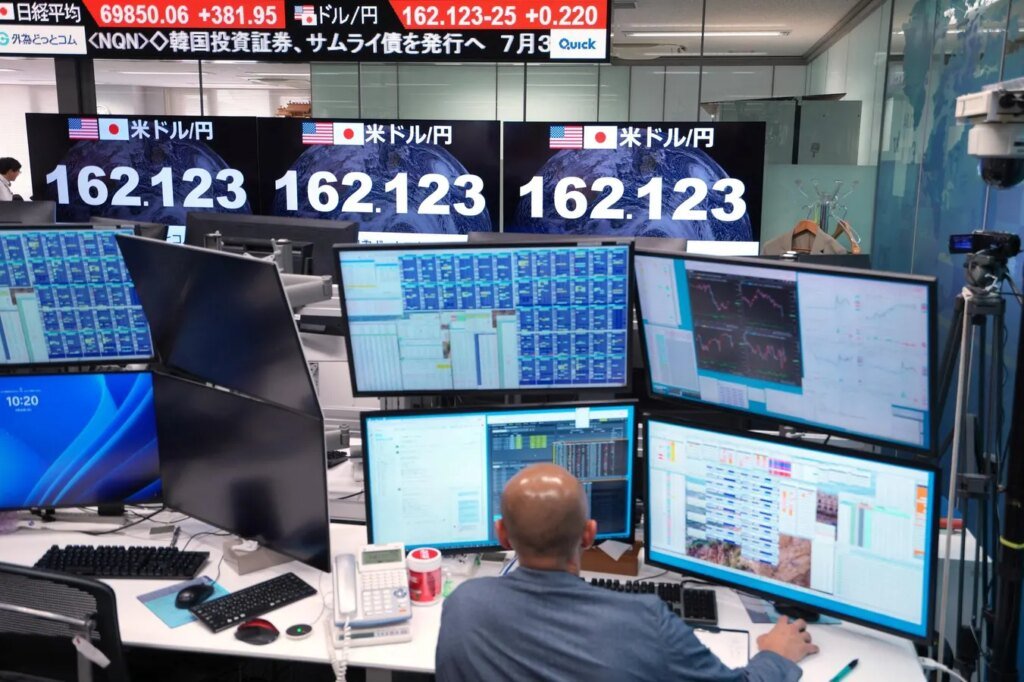

Electronic boards display the foreign exchange rate of the Japanese yen against the US dollar at a foreign exchange brokerage in Tokyo on June 30, 2026. (Photo by Kazuhiro NOGI / AFP via Getty Images)
AFP via Getty Images
Stablecoins aren’t shelter from a high-volatility currency storm. Despite the previous truth, cryptocurrency exchanges and warehouses continue to promote an alternate narrative about stablecoins as the antidote to currency volatility. Don’t buy it.
For evidence, see the dollar/yen panic of the moment. Presently 1 U.S. dollar buys roughly 159 yen, which signals a rapidly declining yen. Traveling back to 2011, a dollar purchased 75 yen.
Given the yen’s decline, is it any wonder that the U.S. and Japanese monetary authorities are worried about the instability implied in the latter? Would it that stablecoin proponents would acknowledge this reality. No chance.
Implied in the stablecoin narrative is that crypto monies that derive their value from a strict peg to the dollar are the picture definition of stability. Except that the narrative is a false one. See the dollar/yen movements yet again.
To which some might say that the yen is the problem, that it’s the currency weakening against a rock-solid dollar. Said another way, don’t let the yen’s demerits cloud perceptions of the dollar along with the stablecoins given life by the dollar. It’s a nice thought, but one that ignores history.
Lest readers forget, part of the present-day alarm about the yen’s decline is that as the Japanese currency’s dollar price in the present reveals, the dollar was the much weaker currency of the two in 2011. Yet periodic dollar weakness is not something that gets much attention from the stablecoin crowd.
All of which calls for an even broader look at the dollar/yen. It can’t be said enough that 159/1 didn’t just happen. It’s of a piece of a longer-term separation of the two currencies. Notable about this separation is that the dollar has been the weaker, more volatile currency, by far.
To grasp this truth, it’s useful to travel back in time to 1971. It was then that the dollar bought 360 yen. In fact, the $1USD/360Y relationship was part of a fixed global exchange rate regime in which a dollar defined as 1/35th of a gold ounce had the world’s major currencies pegged to it
Then President Nixon severed the dollar’s link to gold. Rather than a fixed measure, the dollar would move up and down or sideways depending on the day.
So unstable did the dollar become that currency trading proliferated. On the day you’re reading this, 7 trillion worth of currency trading will take place globally with the dollar on one side of just about every trade. Which is further evidence of the dollar’s instability now, and in the past. The yen instructs.
From its fix of 360Y/1USD in 1971, the yen soared. Said another way, the dollar weakened. A great deal. See 2011 again when a dollar purchased 75 yen after purchasing 360 just 40 years before.
It’s just a reminder that on the matter of instability, including instability that sometimes reveals itself through a substantially shrunken dollar, the dollar has in no way been picture of price certainty for over 55 years.
Please keep this in mind with a CLARITY Act still in the works. Crypto exchanges and warehouses continue to clamor for bank-like status owing to the low-risk “stablecoins” that they’ll bank. They doth protest too much. Explicit in the quotes around stablecoins is a warning to legislators that the most circulated crypto concept is far from a safe, stable measure.
See the dollar’s historical movements to grasp this truth. They’re a loud tell that the stablecoins crypto warehouses want to “safely” bank are many things, none of them stable.