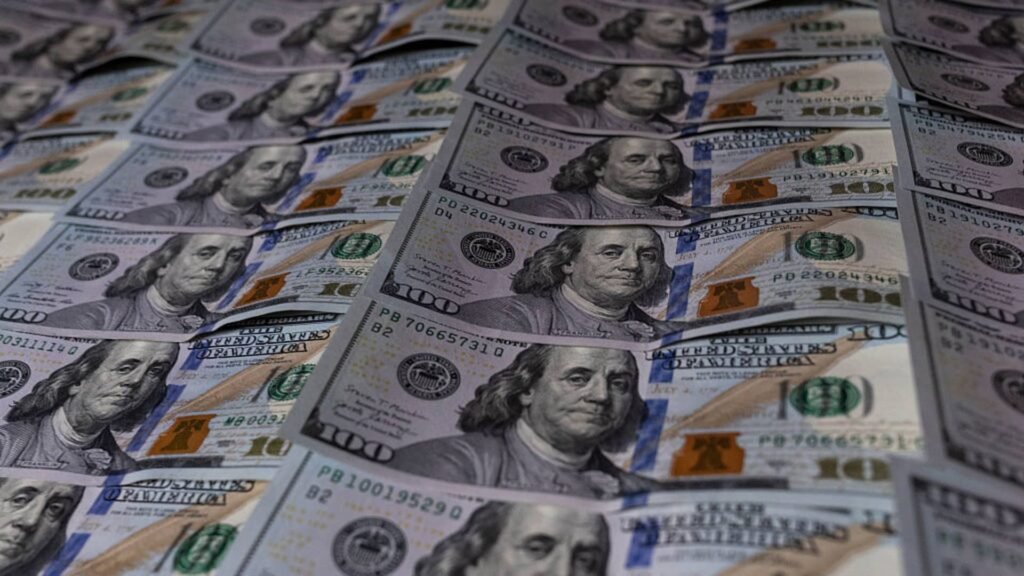
U.S. one hundred dollar bills are shown in Buenos Aires, Argentina, on April 15, 2026.
Matias Baglietto | Nurphoto | Getty Images
The U.S. dollar steadied at a near two-month low on Monday following Friday’s soft jobs data, as investors awaited this week’s inflation data for more clues on the Federal Reserve’s rate path.
Data on Friday showed the U.S. economy unexpectedly shed jobs in July while job gains for the prior two months were revised sharply lower, cooling expectations for a Fed rate hike next month.
The soft labor market data adds extra weight to Wednesday’s consumer price index report as investors look for clues on the path of Fed policy.
The labor market data “was a negative event for the dollar,” said Francesco Pesole, FX strategist at ING. “We think the bias remains negative this week but if we get a hot break on CPI, markets are going to be back to pricing in a rate hike as their baseline.”
The futures market scaled back the chance of a September move up in rates to about 48% from 67% a week ago. A consensus estimate calls for the core CPI to rise 0.2% month-on-month in July, while the annual rate is seen moderating to 2.5% from 2.6% in June.
Producer price data on Thursday and retail sales figures on Friday will further inform the outlook for inflation. The euro was little changed at $1.1555, near its strongest level since mid-June, while sterling was steady at $1.3501, just below its three-and-a-half-week peak touched on Friday.
Yen drops
The yen weakened 0.6% to a low of 158.89 per dollar, heading for its biggest daily drop against the U.S. currency in almost five months. The yen has trimmed some intervention-led gains but is still well off the roughly 1.64 multi-decade low hit late last month.
Speculators slashed their bearish bets on the Japanese yen by the most in over 12 years, according to data on Friday from the Commodity Futures Trading Commission, reflecting the coordinated effort by Japanese and U.S. authorities to strengthen the currency.
The data showed the net short position in the yen fell by $8.865 billion to $3.604 billion in the week to August 4, the largest drop in absolute terms since March 2014. The dollar index, which tracks the currency against six major peers, was little changed at 99.70, after falling to the lowest level since June 15 on Friday. Speculators increased their net long position in the dollar in the latest week to the highest since December 2022, the CFTC said.
Eyes on Iran
Investors are still closely watching talks to reopen the Strait of Hormuz and the impact on energy prices. Oil rose on Monday, with Brent crude futures up over 1.5% at roughly $85 per barrel amid continued uncertainty over the reopening of the strait. Iran said a deal with Oman defining new shipping lanes was in its final stages but added that the U.S. must still meet other conditions, muddling the energy supply outlook.
The Australian dollar was a touch softer at $0.7065 before the Reserve Bank of Australia’s rate decision on Tuesday. The central bank is expected to hold its key rate at 4.35% for the rest of the year. Elsewhere, the Chinese yuan held steady at 6.7442, near its strongest level in 3.5 years, after data showed China’s producer price inflation eased last month.