The Indian Rupee (INR) extends the week-long rally against the US Dollar (USD) on Friday. The USD/INR pair slides to a fresh over two-week low near 95.30 due to the overnight slump in the US Dollar amid growing doubts regarding whether the Federal Reserve (Fed) is seriously committed to bringing the United States (US) inflation down. The Indian currency is up 1%from its previous weekly close at 96.40.
The table below shows the percentage change of Indian Rupee (INR) against listed major currencies this week. Indian Rupee was the strongest against the US Dollar.
| USD | EUR | GBP | JPY | CAD | AUD | INR | CHF | |
|---|---|---|---|---|---|---|---|---|
| USD | -0.91% | -0.81% | -2.19% | -0.48% | -0.45% | -1.21% | -0.84% | |
| EUR | 0.91% | 0.09% | -1.31% | 0.46% | 0.47% | -0.05% | 0.06% | |
| GBP | 0.81% | -0.09% | -1.51% | 0.36% | 0.39% | -0.49% | -0.03% | |
| JPY | 2.19% | 1.31% | 1.51% | 1.75% | 1.79% | 1.20% | 1.28% | |
| CAD | 0.48% | -0.46% | -0.36% | -1.75% | 0.00% | -0.63% | -0.38% | |
| AUD | 0.45% | -0.47% | -0.39% | -1.79% | -0.00% | -0.63% | -0.42% | |
| INR | 1.21% | 0.05% | 0.49% | -1.20% | 0.63% | 0.63% | 0.31% | |
| CHF | 0.84% | -0.06% | 0.03% | -1.28% | 0.38% | 0.42% | -0.31% |
The heat map shows percentage changes of major currencies against each other. The base currency is picked from the left column, while the quote currency is picked from the top row. For example, if you pick the Indian Rupee from the left column and move along the horizontal line to the US Dollar, the percentage change displayed in the box will represent INR (base)/USD (quote).
At press time, the US Dollar Index (DXY), which tracks the Greenback’s value against six major currencies, trades marginally higher to near 100.00; however, it fell almost 0.9% on Thursday to near 99.86.
Investors doubt Warsh will consider rate hikes to tame inflation
According to analysts at ING, “Looking at the market’s reaction [to the Fed’s press conference], the conclusion was that the Fed was not going to be as tough on fighting inflation as initially thought.”
In the policy conference, Fed Chair Kevin Warsh maintained the rhetoric and refused to provide so-called “forward-guidance” on interest rates. However, Warsh said that the central bank will do necessary monetary policy adjustments to combat hot inflation. “Committee remains resolute to deliver price stability, and we will not hesitate to act,” Warsh said.
Elevated oil prices could limit INR’s upside
Oil prices remain higher due to fears of prolonged energy supply constraints amid the ongoing exchange of attacks between the US and Iran, which are expected to limit the upside in the Indian Rupee.
The war between both nations is unlikely to pause anytime soon as Iran continues to demand the recognition of its authority on the Strait of Hormuz. Meanwhile, Iran-aligned Houthis’ intentions to monetize the Bab el-Mandeb Strait, a key link between the southern Red Sea and the Gulf of Aden, are also worsening Middle East tensions.
According to strategists at TD Securities, ongoing disruptions and supply constraints are tightening the global energy balance, with the bank highlighting that “we continue to see reduced flows and global tightening of the energy market as supportive of further upside in crude oil.” This assessment underscores their view that constrained supply dynamics remain a key pillar for potential additional gains in crude prices, even as positioning among some systematic players remains cautious.
Currencies from economies, such as India, which rely heavily on oil imports to meet their energy needs, tend to underperform in a high oil price environment.
RBI to keep policy rates steady next week
Going forward, the major trigger for the Indian currency will be the Reserve Bank of India’s monetary policy announcement on August 5.
Analysts at Commerzbank expect the Reserve Bank of India to maintain a steady policy stance at its upcoming meeting, noting that the RBI is “expected to leave the benchmark repurchase rate unchanged at 5.25% at its next meeting on 5 August.” They acknowledge that “inflation risks remain tilted to the upside due to higher global commodity prices and a weaker monsoon season,” but point out that the latest June CPI print “rose 4.4% yoy, which was within RBI’s 2-6% target range,” reinforcing the case for policy continuity.
Technical Analysis: USD/INR stabilizes below 20-day EMA
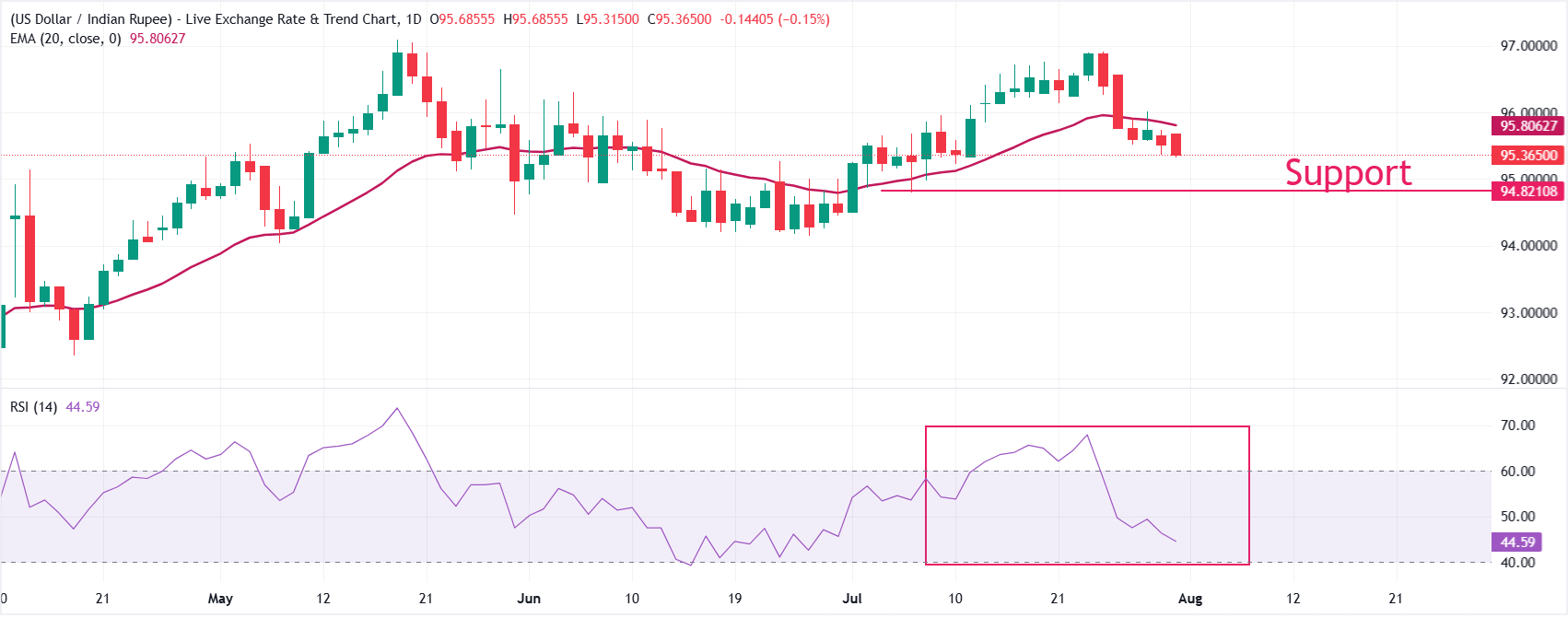
USD/INR extends the decline to near 95.30 on Friday, maintaining a bearish near-term tone as it holds below the 20-day Exponential Moving Average (EMA) at 95.81.
The pair’s inability to reclaim this dynamic resistance suggests rallies remain capped for now, while the Relative Strength Index (RSI) near 44 hints at weakening momentum after the recent advance, reinforcing the risk of further consolidation or downside probes.
On the topside, initial resistance is defined by the 20-day EMA around 95.81, and a daily close above this barrier would be needed to reclaim the 96.00 level. On the downside, the pair is expected to extend the decline toward the July 7 low at 94.80.
(The technical analysis of this story was written with the help of an AI tool. Know more.)
Economic Indicator
RBI Interest Rate Decision (Repo Rate)
The RBI Interest Rate Decision is announced by the Reserve Bank of India. If the bank is hawkish about the inflationary outlook of the economy and rises the interest rates, it is seen as positive, or bullish, for the INR, while a dovish outlook for the economy (or a rate cut) is seen as negative, or bearish, for the currency.
Next release:
Wed Aug 05, 2026 04:30
Frequency:
Irregular
Consensus:
–
Previous:
5.25%
Source:
Reserve Bank of India