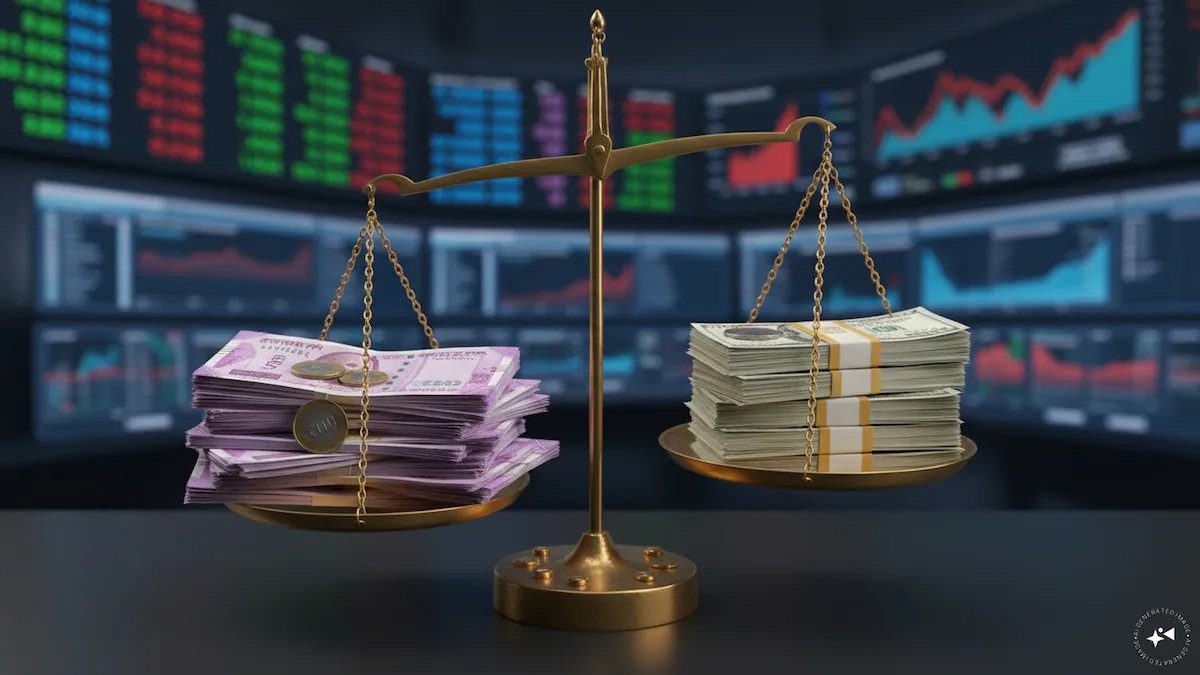
The rupee’s bumpy ride continues. So far this year, the Indian rupee has depreciated by over 6% and has been on a downward trajectory despite the recent slew of measures introduced by the Reserve Bank of India. The weakness in the domestic currency has mostly been attributed to foreign capital outflow and the oscillating tensions between Washington and Tehran.
Last month, the RBI unveiled a series of steps to strengthen capital inflows into the country, under which it will provide full hedging cost support to authorised dealers on fresh foreign currency non-resident bank FCNR (B) deposits.
Other major measures include a concessional swap window for External Commercial Borrowings (ECBs) by state-run companies, tax breaks on government securities for foreign investors, and extending the realisation timeline for exporters.
Following the RBI’s rescue package, the Indian rupee briefly strengthened nearly 2%, climbing around the 94 per dollar mark from lows of 96 per dollar. However, the appreciation was short-lived as it failed to sustain momentum, falling back to the 96 levels.
RBI’s rescue package at a glance
| Measure | Objective |
| Full hedging cost support for fresh FCNR(B) deposits | Attract overseas dollar deposits |
| Concessional ECB swap window for state-run firms | Ease foreign borrowing costs |
| Tax incentives on government securities | Boost foreign portfolio investment in debt |
| Extended export realisation timeline | Improve export-related dollar inflows |
FinancialExpress.com spoke to experts to understand the factors behind the rupee’s continued weakness.
Balance of Payments deficit limits upward momentum
On May 20, the Indian rupee hit a record low of 96.96 against the greenback, with participants citing surging crude prices driven by the West Asia conflict as the primary trigger for its decline. Although oil prices cooled briefly, the currency continued to trade range-bound within the 94-96 range against the US dollar.
Experts believe one of the biggest factors limiting the currency’s appreciation is the balance of payments (BoP) deficit the country has been recurring over the past two years. “The problem with rupee was not just the current account deficit, but also the balance of payments deficit,” said Ritesh Bhansali, CEO, Mecklai Financial Services.
India’s balance of payments (BoP) recorded a depletion of $23.6 billion in FY26, significantly wider than the $5.03 billion deficit reported in FY25.
“While the current account was low, the capital account was weak, which put pressure on the rupee,” said Madan Sabnavis, Chief Economist, Bank of Baroda. India’s capital account recorded a deficit of $2.4 billion in May 2026 against a surplus of $3.7 billion in the same month last year.
| Indicator | Latest data |
| Rupee all-time low | 96.96/USD |
| FY26 BoP balance | – $23.6 billion |
| FY25 BoP balance | -$5.03 billion |
| Capital account (May 2026) | -$2.4 billion |
| Capital account (May 2025) | +$3.7 billion |
How FCNR inflows impact dollar liquidity
Although the central bank has re-introduced its swap facility, last used during the 2013 rupee crisis, it is important to note this time it has been brought forth to strengthen the balance of payments and encourage capital inflows, which in turn would support the rupee.
“Policies are never taken to make the rupee appreciate as such, and often RBI buys dollars to stabilise the rupee when there is sharp appreciation. The RBI has stated that it has no price view but will intervene when there is volatility,” explained Sabnavis.
Indian banks have mobilised nearly $32 billion through the FCNR (B) deposits, RBI governor Sanjay Malhotra told The Hindu BusinessLine in an interview. According to Anindya Banerjee, Head of Currency & Commodity Research, Kotak Securities, the scheme may bring in flows worth $50-60 billion, provided that the current run rate holds and there is an end-phase surge in the last few weeks of September.
Garima Kapoor, Deputy Head of Research & Economist at Elara Securities India, elaborated that RBI’s measures for FCNR (B) and ECB are essentially a function of the second quarter (July-August), where actual dollar inflows will start to get booked.
“So, if let’s say you do not face any negative geopolitical developments…the expectation is that you might see a gradual rupee appreciation towards 93 up to 94 level over the next couple of months,” added Bhansali of Mecklai.
Reserve accumulation Vs currency appreciation
The Elara economist noted that foreign inflows have not eased enough to provide for currency strengthening. “One of the main factors preventing the rupee’s appreciation is that the flows have not yet started to come down materially,” the economist said. She added that government measures have helped attract FPI inflows into debt.
According to NSDL data for June, foreign portfolio investors poured in Rs 55,518 crore in debt markets but continued to remain net sellers in the equity segment. Despite these inflows, economists add that the rupee may not witness strong near-term appreciation, as the RBI may absorb inflows to replenish foreign exchange reserves.
“The biggest constraint remains the RBI’s reserve accumulation strategy. Whenever meaningful dollar inflows emerge, the central bank has generally purchased dollars to strengthen India’s foreign exchange reserves, preventing excessive rupee appreciation while maintaining external competitiveness,” said Kunal Sodhani, treasury head at Shinhan Bank.
Why is the rupee still under pressure?
| Factor | Impact on the rupee |
| Balance of Payments deficit | Limits sustained appreciation |
| Weak capital account | Reduces foreign currency inflows |
| RBI reserve accumulation | Absorbs dollar inflows, capping rupee gains |
| RBI’s $100 billion forward book | Limits one-way appreciation |
| Strong US Dollar Index | Keeps emerging market currencies under pressure |
| West Asia geopolitical tensions | Drives safe-haven demand for the US dollar |
The $100 billion forward book short position factor
Economists add that one-way appreciation is unlikely as the RBI will absorb inflows to offset its dollar positions in the forward market. The central bank’s net dollar sales touched a record of $106.6 billion at May-end.
“Then also one other aspect to remember is that RBI will not allow all the flows to come unsterilised. Remember, RBI is looking at a forward book, which is short position of more close to $100 billion,” added Kapoor.
Strong US Dollar Index keeps emerging currencies under pressure
Currency experts also believe that a strong US dollar index is also limiting the scope of upside for the Indian rupee. The dollar index, which gauges the strength of the greenback against a basket of six major currencies, has strengthened over 3% on a calendar year basis.
Economists have said that the US Federal Reserve’s monetary path and geopolitical developments are going to be the key determinants for the rupee’s trajectory. Amidst the ongoing tensions between Washington and Tehran, traders weigh in at least one rate hike by the Fed.
“In the near term, I think the most important factor that is weighing on the currency is going to be the global backdrop where the dollar is headed, and the answer to that depends on the US monetary policy,” said Garima Kapoor, Economist at Elara Capital.
A firm dollar makes emerging market currencies like the Indian rupee less appealing for overseas investors by increasing the safe-haven appeal of the greenback.
Global investor sentiment: Constructive or defensive?
Experts differ on the global market sentiment towards the Indian rupee, stating developments across West Asia continue to be a key factor influencing its trajectory.
Bank of Baroda’s Sabnavis said that the broader sentiment is positive following the RBI’s measures unveiled last month. However, Sabnavis does not expect the currency to appreciate from its current levels, stating that foreign inflows will be absorbed to build reserves rather than support the spot currency.
In contrast, Kunal Sodhani of Shinhan Bank said global sentiment is cautiously constructive over the medium term, supported by India’s strong macroeconomic fundamentals. However, he noted that investors remain defensive in the near term due to global uncertainty, expectations of a hawkish US Federal Reserve, and concerns over India’s external balances, keeping the rupee under a depreciating bias.
Meanwhile, Ritesh Bhansali said the global sentiment towards the rupee remains largely neutral. He added that comments by US President Donald Trump continue to influence market narratives and investor sentiment, contributing to short-term volatility in the currency.
Conclusion
The Indian rupee is unlikely to see meaningful appreciation as the steps undertaken by the RBI are mainly aimed at strengthening the country’s balance of payments and containing runaway depreciation.
Geopolitical uncertainties continue to limit the scope of upside for emerging-market currencies, with foreign investors diverting towards US dollar securities in periods of stress.
According to experts, the Indian rupee remains undervalued on a real effective exchange rate, compared with its peers. They added that RBI’s measures are primarily aimed at building reserves and meeting future obligations, rather than driving a sharp appreciation in the currency.
Disclaimer: This article is based on interactions with market economists and publicly available data from the Reserve Bank of India (RBI), NSDL and other official sources. The views and opinions expressed by the experts quoted are their own and do not necessarily reflect those of FinancialExpress.com. Currency markets are subject to rapid changes due to global economic, geopolitical and policy developments. This article is for informational purposes only and should not be construed as investment, trading or financial advice.