The Indian Rupee gains strongly after a flat opening against the US Dollar (USD) on Friday. The USD/INR pair declines to near 96.50 as the Reserve Bank of India (RBI) has intervened again to support the Indian Rupee.
According to a Reuters report, the Indian central bank is likely selling US Dollars near 96.80 INR levels. The report also showed that state-run banks were spotted offering US dollars, most likely on the RBI’s behalf.
On Thursday, rumours emerged that the RBI also intervened in spot and non-deliverable forwards (NDFs) markets to provide a cushion to the Indian currency.
However, the provisional support by the RBI is expected to be short-lived as surging oil prices and the revival of Federal Reserve (Fed) interest rate expectations will likely batter the Indian Rupee soon.
Escalating US-Iran conflict keep oil prices higher
Oil prices have rallied significantly in the past few weeks due to renewed military aggression between the United States (US) and Iran. In retaliation, Yemen’s Iran-aligned Houthis have closed the Bab el-Mandeb Strait, the southern gateway of the Red Sea, which has squeezed global energy supply further.
No signs of a diplomatic breakthrough between the nations have prompted fears that oil supply tightness could be prolonged, a scenario that bodes poorly for currencies from economies, such as India, which rely heavily on oil imports to meet their energy needs.
Rising oil prices revive hawkish Fed bets
Fed interest rate hike expectations have shown a resurgence as surging oil prices have de-anchored inflation projections. According to the CME FedWatch tool, the odds of the Fed delivering an interest rate hike at the policy meeting next week stand at 35.8%, significantly higher than the 11.8% recorded last week.
The revival of hawkish Fed bets has prompted US Treasury Yields, which typically result in diminishing the appeal of risky currencies. At press time, US Treasury Yields trade at around 4.70%, the highest level seen since January 2025.
Higher US bond yields have also strengthened the US Dollar. In the Asian trade, the US Dollar Index (DXY), which tracks the Greenback’s value against six major currencies, trades firmly near the three-week high at around 101.50 posted on Thursday.
India’s private sector PMI growth cools down
India’s flash HSBC Composite Purchasing Managers’ Index (PMI) data for July arrives at 54.3, lower than 57.1 in June. A slowdown in both manufacturing and service sector activity has weighed on the overall PMI number.
“Renewed tensions in the Middle East have once again resulted in firms building buffers to manage the uncertainties around the longevity of the supply-side shock. Finished goods and input inventories increased alongside a pick-up in purchasing volumes. Both, output and new export orders rose, even as the overall manufacturing growth eased slightly. Price pressures firmed, with output charge inflation gathering pace and signalling a renewed push to protect margins,” Pranjul Bhandari, Chief India Economist at HSBC, said.
Technical Analysis: USD/INR aims to revisit all-time high near 97.10
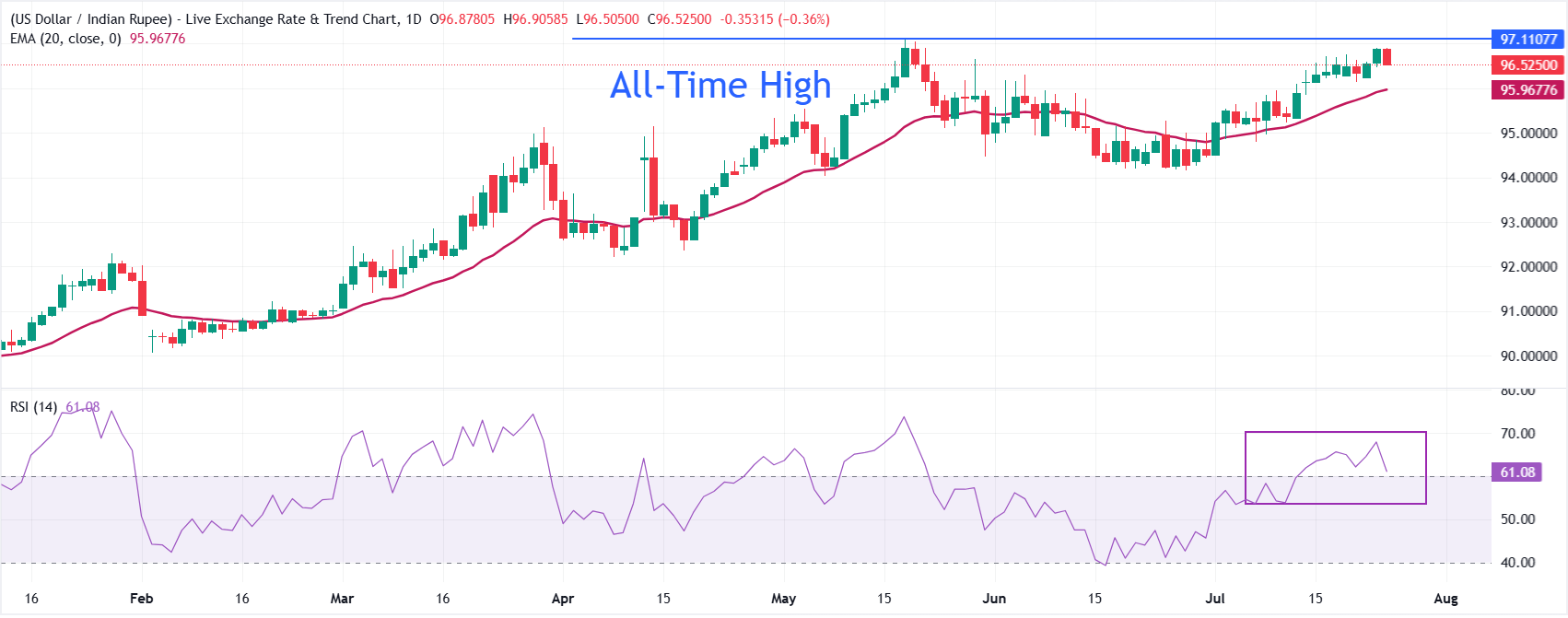
USD/INR trades lower at around 96.50 at the time of writing, but is holding its advance above the 20-day Exponential Moving Average (EMA) at 95.9678 and keeping a constructive bullish bias intact.
The positioning over this short-term trend gauge suggests dips are being absorbed, while the Relative Strength Index (RSI) around 61 on the daily chart points to firm but not yet overbought upside momentum.
On the downside, immediate support is located at the 20-day EMA near 95.97, where buyers would be expected to defend the uptrend on pullbacks. Looking up, the all-time high at around 97.10 will be the key resistance level
(The technical analysis of this story was written with the help of an AI tool. Know more.)
Indian Rupee FAQs
The Indian Rupee (INR) is one of the most sensitive currencies to external factors. The price of Crude Oil (the country is highly dependent on imported Oil), the value of the US Dollar – most trade is conducted in USD – and the level of foreign investment, are all influential. Direct intervention by the Reserve Bank of India (RBI) in FX markets to keep the exchange rate stable, as well as the level of interest rates set by the RBI, are further major influencing factors on the Rupee.
The Reserve Bank of India (RBI) actively intervenes in forex markets to maintain a stable exchange rate, to help facilitate trade. In addition, the RBI tries to maintain the inflation rate at its 4% target by adjusting interest rates. Higher interest rates usually strengthen the Rupee. This is due to the role of the ‘carry trade’ in which investors borrow in countries with lower interest rates so as to place their money in countries’ offering relatively higher interest rates and profit from the difference.
Macroeconomic factors that influence the value of the Rupee include inflation, interest rates, the economic growth rate (GDP), the balance of trade, and inflows from foreign investment. A higher growth rate can lead to more overseas investment, pushing up demand for the Rupee. A less negative balance of trade will eventually lead to a stronger Rupee. Higher interest rates, especially real rates (interest rates less inflation) are also positive for the Rupee. A risk-on environment can lead to greater inflows of Foreign Direct and Indirect Investment (FDI and FII), which also benefit the Rupee.
Higher inflation, particularly, if it is comparatively higher than India’s peers, is generally negative for the currency as it reflects devaluation through oversupply. Inflation also increases the cost of exports, leading to more Rupees being sold to purchase foreign imports, which is Rupee-negative. At the same time, higher inflation usually leads to the Reserve Bank of India (RBI) raising interest rates and this can be positive for the Rupee, due to increased demand from international investors. The opposite effect is true of lower inflation.