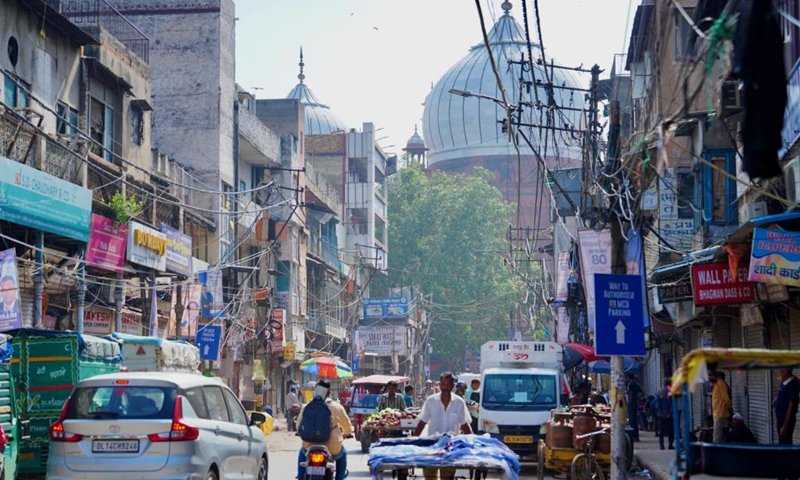
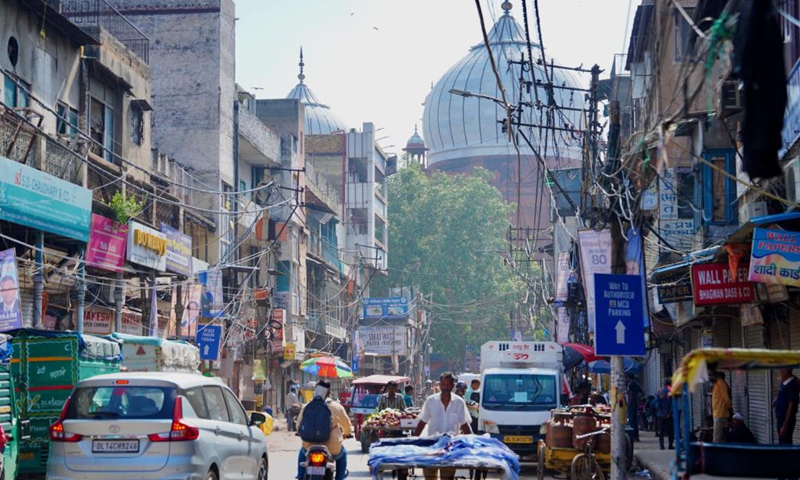
This photo taken on Aug. 21, 2025 shows a street view in New Delhi, India. India boasts a diverse and rich culture, attracting global attention with its historical heritage, Bollywood film industry, yoga culture, and more. Photo: Xinhua
By late 2025, headlines celebrating India’s ascent to the world’s fourth-largest economy dominated Indian media coverage. Yet just months later, in April 2026, the Times of India reported that IMF data showed India’s GDP, measured in US dollar terms, stood at approximately $3.92 trillion in 2025, making it the world’s sixth-largest economy.
The IMF’s latest World Economic Outlook showed that India’s GDP growth still clocks in at 6.5 percent — an impressive-looking figure. However, the currency depreciation may weigh on real GDP growth.
Xinhua reported that the Indian rupee has continued to weaken against the US dollar, hitting a record low on May 20, when it briefly touched 96.9650 per dollar. More recently, the exchange rate stood at 94.80 at the time of writing. Industry insiders expect that if the rupee continues to depreciate rapidly, the Reserve Bank of India may be forced to intervene more actively, while Indian government agencies may already be preparing countermeasures. In addition, the government could also roll out measures aimed at attracting foreign capital inflows, said Xinhua.
While Indian Prime Minister Shri Narendra Modi’s response was to urge citizens to avoid unnecessary foreign travel, buy less gold and consume less fuel, according to BBC’s report. As some Indian medias have boasted the country as “world’s faster growing economy,” analysts said depleted foreign exchange reserves and a depreciating currency are merely the trigger, while noting that the deeper causes run in multiple directions.
The failure to build a manufacturing base ranks as a primary one. Since Modi took office in 2014, revitalizing manufacturing has been a central pillar of his economic agenda. His flagship “Make in India” initiative set an ambitious target: raise manufacturing’s share of GDP to 25 percent by 2025. The outcome has been the opposite. World Bank data show that India’s manufacturing value added accounted for just 13 percent of GDP in 2024, down from 15 percent a decade earlier.
Indian scholar Rahul Menon, writing in The Hindu and citing economist Arvind Subramanian, argues that high wages in the government sector draw labor away from manufacturing, pushing up overall wage costs and eroding industrial competitiveness — offering one explanation for why India has failed to industrialize on the scale of China or South Korea.
When domestic demand cannot be adequately met by local production, trade deficits tend to become entrenched. According to Indian media Business Standard, citing official data, India’s imports rose 10 percent year-on-year to $71.94 billion in April despite goods exports reaching a four-year high, widening the trade deficit to $28.38 billion, the highest level in three months. Data from Trading Economics showed that India’s trade deficit, measured in US dollars, has expanded roughly fivefold over the past decade.
China, by contrast, has continued to expand its industrial strength. According to National Statistics Bureau, China’s industrial value-added reached 41.7 trillion yuan, up 5.8 percent year-on-year, contributing 35 percent to overall economic growth in 2025. High-end, intelligent, and green manufacturing led the charge, with output from equipment manufacturing and high-tech manufacturing rising 9.2 percent and 9.4 percent respectively.
China’s ability to build the world’s most complete industrial supply chain reflects decades of capitalizing on every available advantage — human resources, policy consistency, and the openings provided by globalization, Qian Feng, director of the research department at the National Strategy Institute at Tsinghua University, told the Global Times on Monday. India, by comparison, lags significantly across all three dimensions: workforce education levels, economic policy stability, and industrial foundations, producing a manufacturing gap that is both wide and deeply entrenched, Qian noted.
In addition, India’s business environment has also driven foreign capital away. Chinese firms, including Xiaomi and OPPO, have faced tax investigations and asset freezes by Indian regulators, while NVIDIA and Tesla have seen their localization plans stall amid policy friction, according to media reports. Qian described India’s core problem as “selective enforcement” — a pattern applied disproportionately to foreign enterprises and a persistent grievance among international investors. The numbers tell the story. According to The Times of India on May 29, in the first nine months of fiscal year 2025-26, only $3 billion in net FDI flowed into the country. In 2022-23, that figure stood at $28 billion.
Continued capital outflows from India’s stock market have further increased pressure on the rupee. Data show that global investors have withdrawn a total of about $23 billion from Indian equities so far this year, exceeding last year’s full-year foreign outflow, according to the Xinhua report citing foreign media.
China has taken the opposite approach. The commitment to “keep working to foster a first-rate business environment” and “steadily expand opening up at the institutional level” has been written into the latest Government Work Report. Data released by the Ministry of Commerce shows that the number of foreign-invested enterprises operating in China has risen for three consecutive years, now exceeding 530,000, with total stock of foreign investment surpassing $3.6 trillion. Since the start of this year, the ministry has convened five roundtable meetings with foreign enterprises, resolving more than 180 specific concerns raised through regular communication channels.
This round of crisis on India’s foreign exchange has a direct external trigger — the energy crisis stemming from the conflict in the Middle East. As a country heavily dependent on imported crude oil, India is acutely exposed to oil price volatility, according to Qian. But this external shock has landed on top of long-accumulated domestic policy issues under the Modi government. Together, the two forces have driven down foreign direct investment, sustained pressure on the rupee, and dragged India’s GDP ranking lower, he said. However, Qian cautioned against reading too much into short-term fluctuations in GDP rankings.
“India’s sheer economic scale and population base mean it has long been a regional power, and that standing is not in question. But when measured against genuinely global powers like China or the US, the gap remains still vast,” he said.