By Kevin Buckland and Lucy Raitano
TOKYO/LONDON, May 21 (Reuters) – The U.S. dollar firmed on Thursday but stayed below a six-week peak as hopes that Washington was nearing a deal with Tehran to end the war in the Middle East capped further rises.
U.S. President Donald Trump on Wednesday said negotiations with Tehran were in the final stages, while also warning of further attacks if Iran does not agree to a deal.
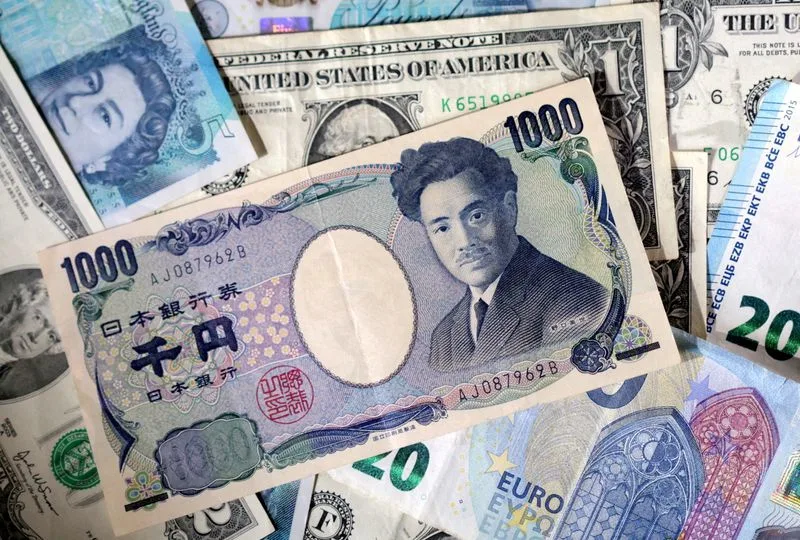
The dollar, often a safe haven for investors, firmed 0.1% against the yen to 159.060 yen after falling for the first time in eight sessions against the yen on Wednesday.
Bank of Japan policy board member Junko Koeda added a measure of support for the yen with hawkish comments on Thursday, saying in a speech that the central bank needs to continue to raise rates with underlying inflation already around a 2% target.
The euro was 0.2% down at $1.160050, after dipping on Wednesday to its weakest level since April 7 at $1.1583 before bouncing back.
The euro dipped after French PMIs for May showed the economy contracting at its sharpest pace in five and a half years.
“Terrible French PMI … but ECB seems determined to raise rates,” said Kenneth Broux, head of corporate research FX and rates at Societe Generale, to explain the negative euro.
Traders meanwhile are awaiting euro area composite PMIs for May which will hit screens this morning.
Sterling was down 0.1% at $1.3421.
The dollar index, which measures the currency against the euro, yen and four other rivals, rose 0.2% to 99.295, down from a peak of 99.472 on Wednesday, the strongest level since April 7.
“The ‘safe haven’ flows reversed because of positive news about the Iran war,” wrote Joseph Capurso, head of FX at Commonwealth Bank of Australia, in a client note.
At the same time, “while the U.S. has domestic political incentives to seek peace, we would not be surprised if President Trump chooses military escalation to gain leverage in negotiations,” he said.
Market focus has been on the potential inflationary impact of higher energy prices as the Strait of Hormuz remains largely closed to shipping.
In a note Commerzbank FX analysts said many central banks may label the inflation shock as transitory should the Strait open in the next few days, but this would be incorrect as it does not take into account loss of purchasing power.
“Consequently, currencies are likely to benefit in countries where the central bank is slower to speak of transitory price spikes but may nevertheless tighten monetary policy,” they wrote.
Notes from the Federal Reserve’s April meeting, published on Wednesday, revealed officials’ intensifying concerns about inflation, with a growing number open to the possibility that they may need to raise interest rates.
Elsewhere, the Australian dollar declined following a surprise rise in the unemployment rate to the highest since 2021, which reduced the case for higher interest rates.
The Aussie slipped 0.55% to $0.71105 as traders pared back bets for Reserve Bank of Australia tightening this year.
“Our call for the RBA to pause in its June policy meeting is now high-conviction,” Westpac economist Ryan Wells wrote in a research report.
“Still, the most immediate and pressing concern for the RBA is inflation. We continue to expect that the RBA will resume raising the cash rate when the size and pace of pass-through of the energy price shock is revealed.”
Bitcoin softened a fraction to around $77,603.16.
(Reporting by Kevin Buckland; Editing by Kim Coghill, Jacqueline Wong and Thomas Derpinghaus)