After four brutal sessions that wiped 4 per cent off India’s benchmark indices and erased over ₹10 lakh crore in investor wealth, the Sensex and Nifty showed signs of a tentative recovery on Thursday morning, after closing flat but in the green a day earlier.
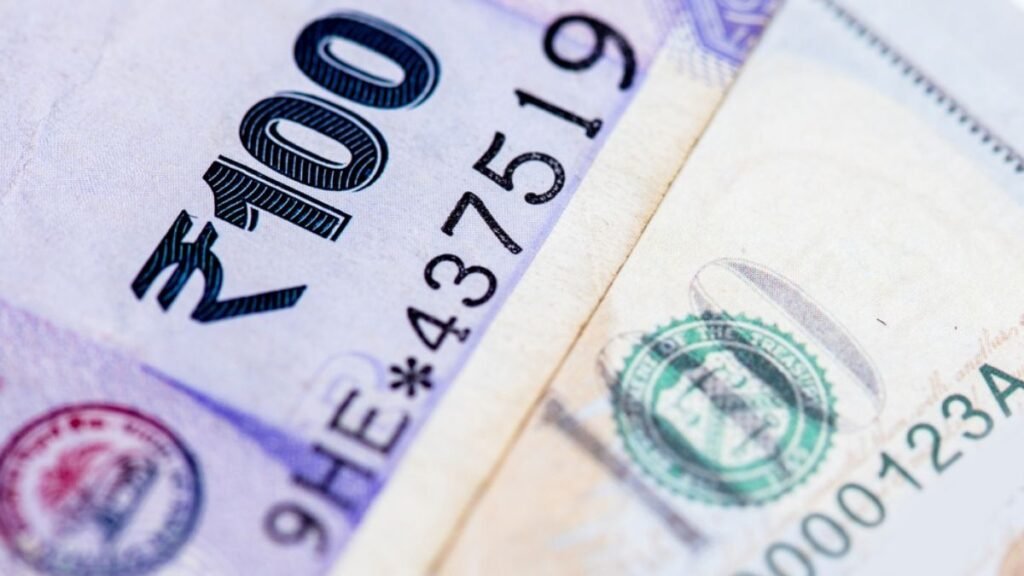
By noon, the BSE Sensex climbed 886 points to trade as high as 75,495.08, and the Nifty 50 gained 295 points to a 23,708.30 high. But the headline numbers mask the fragile state of the Indian currency. Even as stocks climbed, the Indian rupee fell 20 paise to yet another record low of 95.86 against the US dollar on Thursday morning, making it Asia’s worst-performing currency of 2026, having weakened around 6 per cent since the West Asia conflict began in late February.
The dollar index was at 98.48, and Brent crude traded at around $106–108 per barrel, still dangerously elevated after touching a four-year high of $126/barrel on April 30.
The market’s split personality on Thursday was sharp and sector-specific. Banking stocks and select large-caps led the charge. Bharti Airtel became the top Sensex performer, gaining 3.6 per cent after reporting strong quarterly earnings. HDFC Bank was up 2.8 per cent while Eternal rose by 2.5 per cent.
In contrast, the IT sector fell, with HCL Tech slumping 3.2 per cent as the biggest loser, followed by Tech Mahindra, Infosys, and TCS. However, this was an unusual reversal, since IT exporters are typically the biggest beneficiaries of a weaker rupee. The selling likely reflects global investor rotation away from growth and technology names amid geopolitical uncertainty. Small-cap and mid-cap indices also slipped in early trade, which meant that the recovery has not yet broadened beyond large-caps.
Foreign Institutional Investors (FIIs) have now sold a net $23.2 billion of Indian equities in 2026, that too, at an unprecedented pace. On Wednesday alone, FIIs offloaded stocks worth ₹4,703.15 crore, while Domestic Institutional Investors (DIIs) partially absorbed the pressure by buying ₹5,869.05 crore.
This meant that while domestic buying kept markets from collapsing, it seems not to have prevented the slow structural erosion in sentiment.
The one source of global optimism is the Trump-Xi summit in Beijing, a high-stakes two-day meeting that began Thursday. Chinese President Xi Jinping called 2026 a “historic, landmark year” for US-China relations, and global markets reacted positively to the prospect of reduced trade friction.
However, Trump has stated he does not expect China’s help in resolving the Iran conflict, keeping the Strait of Hormuz situation unchanged.
What a sliding rupee does to India
For the general Indian household, the rupee’s decline is also a cost-of-living story. A weaker rupee directly inflates import costs for crude oil (India imports 87 per cent of its needs), fertilisers, edible oils, electronics and industrial machinery.
This feeds into retail inflation, eroding purchasing power across income levels. Companies with foreign-currency debt face higher repayment costs as the rupee falls, squeezing margins and potentially delaying investment. According to ICICI Direct, capital outflows triggered by currency weakness can further reduce FDI inflows, compounding the pressure.
The one structural positive is for exporters and the remittance economy. India’s IT sector, the rupee’s traditional ally in depreciation cycles, earns in dollars and reports in rupees. A weaker rupee boosts reported earnings.
Similarly, 38 per cent of India’s annual remittances that originate from Gulf countries are worth more in rupee terms. But these gains are being overwhelmed right now by the import bill shock from elevated crude and the gold duty hike.