![A currency exchange office at Incheon International Airport is pictured on March 22. [NEWS1]](https://koreajoongangdaily.joins.com/data/photo/2026/03/23/3cc96aad-dd7a-49a1-93f2-4688ea80d641.jpg)
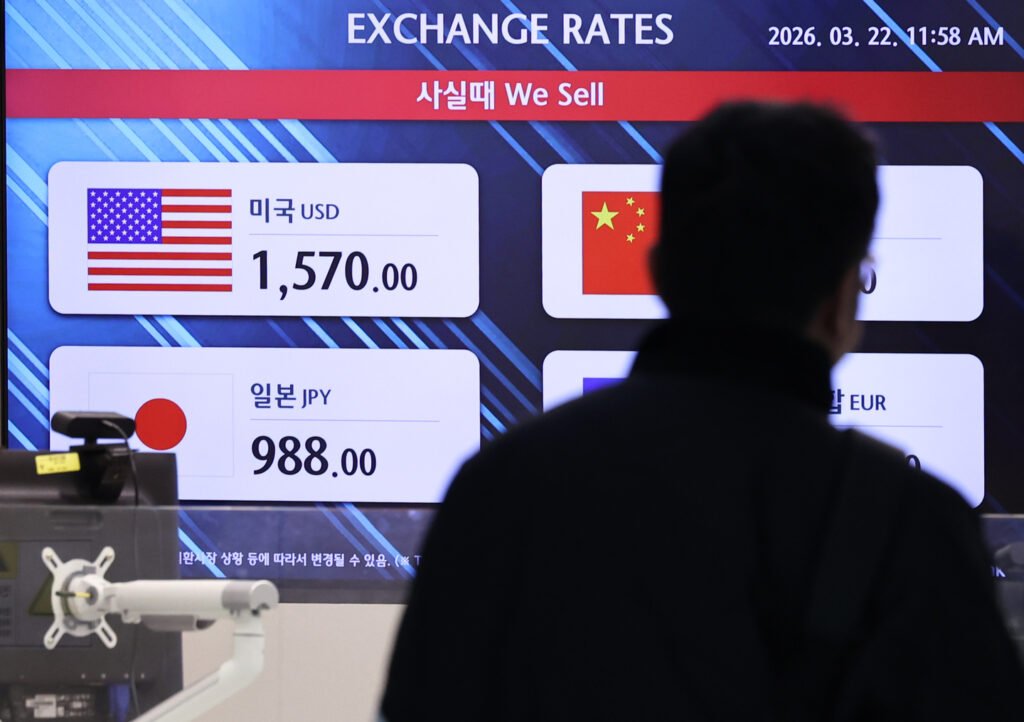
A currency exchange office at Incheon International Airport is pictured on March 22. [NEWS1]
The dollar-won exchange rate rose above 1,510 won on Monday, marking its highest level in 17 years since the 2008 financial crisis.
The dollar-won exchange rate averaged 1,493.29 for the week of March 16 to Friday, according to the Seoul Money Brokerage Services on Sunday. The monthly average reached 1,483.4, nearing levels seen during the 1997 Asian financial crisis, and the year-to-date average of 1,461 marks the highest since that period as well.
On a closing basis, the exchange rate remained in the 1,500 won range for two consecutive sessions, which has raised expectations that a new baseline has formed. Rates quoted at bank counters have climbed to the 1,530 range, and airport exchange booths have reached as high as 1,570 won, indicating that consumers are already experiencing levels well above 1,500.
The rise in the dollar-won rate cannot be attributed solely to the dollar’s strength. During the same period, the dollar index — which tracks the U.S. currency against six major peers — fell 1 percent, but the euro, yen and pound all strengthened. In contrast, the won weakened 0.48 percent, weighed down by increased dollar demand driven by high oil prices and roughly 29.9 trillion won ($19.83 billion) in net foreign selling over the past five weeks.
Authorities have sought to curb volatility through verbal intervention and market smoothing measures, but analysts say there are limits to bringing the exchange rate down. While Korea’s foreign reserves stand at around $410 billion, prolonged intervention could risk unsettling markets.
![Motorists refuel at the gas station on the Yeongdong Expressway in Yongin, Gyeonggi, on March 22. [NEWS1]](https://koreajoongangdaily.joins.com/data/photo/2026/03/23/74f64a10-f3f1-445e-be5a-201d823b966b.jpg)
Motorists refuel at the gas station on the Yeongdong Expressway in Yongin, Gyeonggi, on March 22. [NEWS1]
Analysts say the outlook for the currency will depend largely on whether tensions in the Middle East escalate further. Jeong Yong-taek, an analyst at IBK Securities, said the exchange rate could rise to 1,550 won in the event of a full-scale conflict.
Park Hyeong-jung, an economist at Woori Bank, said the upper range could extend to 1,600 won, citing diminished expectations for U.S. rate cuts and continued dollar strength.
Market interest rates are already climbing. The yield on three-year Korean government bonds rose from 3.041 percent at the end of February to 3.42 percent in early March and stood at 3.41 percent on Friday.
The five-year bank bond yield — a benchmark for fixed-rate mortgages — increased from 3.572 percent on Feb. 27 to 3.907 percent on Friday. Yields on three-year corporate bonds have also climbed to 3.997 percent, raising borrowing costs for businesses.
Rising oil prices linked to Middle East tensions have revived inflation concerns, prompting the U.S. Federal Reserve and major European central banks to maintain rates while reinforcing a hawkish stance. Expectations for rate cuts this year have largely faded, with some observers even pointing to the possibility of further hikes, which would increase upward pressure on global and domestic rates.
The Bank of Korea faces a difficult policy environment. The interest rate gap with the United States — currently as wide as 1.25 percentage points — limits room for maneuver. While raising rates could help support the won, it would also increase borrowing costs and strain liquidity. Signs of financial stress are already emerging, with delinquency rates at major banks rising and those among small- and medium-sized enterprises continuing to climb.
Government plans for a supplementary budget tied to the Iran war may add to upward pressure on market rates through increased bond issuance.
“Korea is in a position in which it is difficult to either raise or lower rates due to the burden on domestic demand,” Joo Won, the deputy director of economic research at the Hyundai Research Institute, said.
![Dollar bills [REUTERS/YONHAP]](https://koreajoongangdaily.joins.com/data/photo/2026/03/23/59414cc4-b050-412f-b97b-7a1acfc09f1d.jpg)
Dollar bills [REUTERS/YONHAP]
The combined pressures of stabilizing the exchange rate, managing interest rates and maintaining financial stability are increasingly being passed on to consumers. The Korea Development Institute estimates that a 1 percent rise in the exchange rate adds about 0.04 percentage points to consumer inflation. With the won above 1,500 and oil prices exceeding $110 per barrel, inflationary pressure is expected to grow.
Higher rates are also increasing household debt burdens, and overseas expenses are rising with the weaker won. As exchange rates, borrowing costs and energy prices all remain elevated, financial strain on both households and businesses is likely to intensify.
Yang Jun-sok, an economics professor at the Catholic University of Korea, warned that prolonged conflict could lead to supply disruptions. Prof. Yang noted that while higher prices may be manageable, a breakdown in supply could halt economic activity.
Kang Sung-jin, an economics professor at Korea University, described the current volatility as a classic supply-side shock from rising oil prices, which raises the risk of stagflation.
“Policy is constrained. Rates should be lifted to curb inflation, but the risk of a recession makes that choice difficult,” Prof. Kang said, adding that a prolonged war could produce a complex crisis of simultaneous price and currency pressures that would be hard to counter with policy.
This article was originally written in Korean and translated by a bilingual reporter with the help of generative AI tools. It was then edited by a native English-speaking editor. All AI-assisted translations are reviewed and refined by our newsroom.
BY KIM WON [[email protected]]