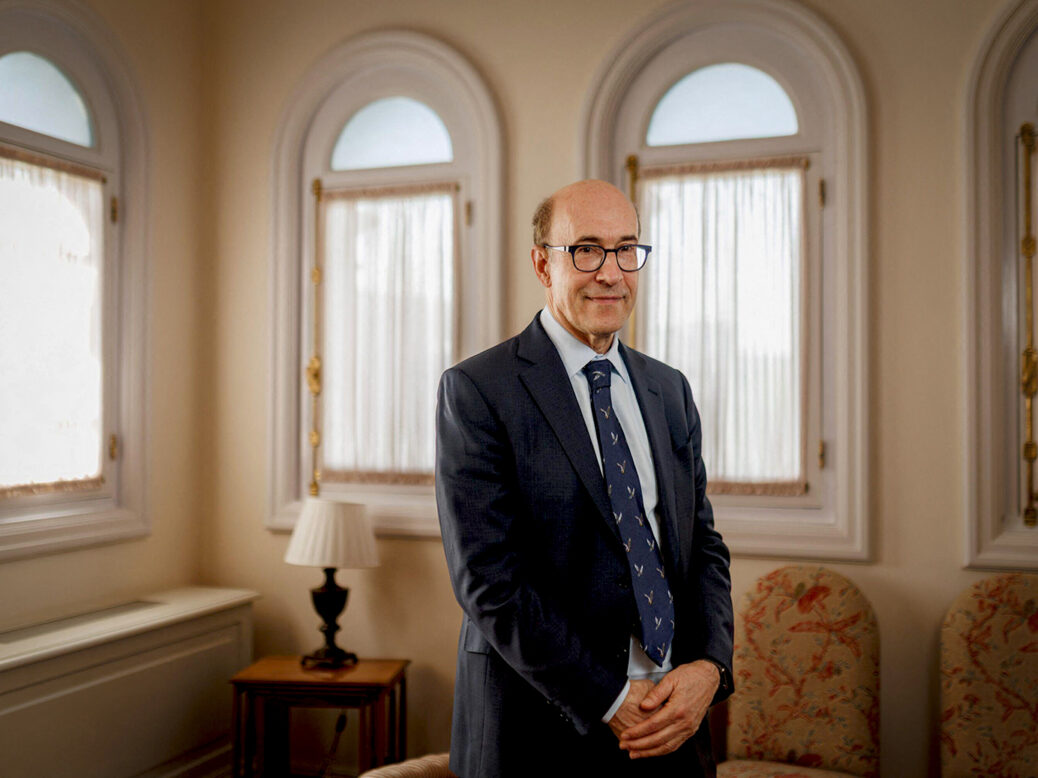
One of Kenneth Rogoff’s friends was watching the news on TV recently when they saw an advert for a gold trading company. Part of the company’s offer, in its inducement to invest, was: “write to us, and we’ll send you a free copy of Ken Rogoff’s book!” Gold companies have bought thousands of copies of his latest work, Our Dollar, Your Problem. The book traces the dollar’s path to power as the globally dominant currency, but also – and this is the part the gold investors were interested in – its prediction that this hegemony will not last. Hours before I met Rogoff in London this week, the spot price of gold rose about $5,500 an ounce – an expression of fear and doubt in a financial system on which America’s money is gradually losing its grip.
He finished writing the book in October 2024. Book publishing, especially in a university press, isn’t the fastest business, so it took another six months before it was released, but the timing could not have been better: it coincided with Trump’s announcement of “Liberation Day” tariffs on almost every country in the world. Before the book was published, he had discussed its premise with academics and financiers, and he had been told that while they respected his ideas on real interest rates and the rise of China, he was wrong about the dollar: “no way”, they told him, “that’s just never going to happen”. And then it did, and the same people contacted him – perhaps with a nervous eye on their portfolios – to ask why he hadn’t warned them more forcefully.
Rogoff’s work focuses on how countries manage their currencies relative to others. This is work that takes in geopolitics and taxation and spending decisions of governments alongside the monetary policy of central banks. Exchange rates can change very quickly (especially when the US has a president who claims, as Trump did this week, that he could manipulate the dollar to “go up or go down like a yo-yo”.) What Rogoff studies is the dollar’s market power, its use as the “lingua franca” of global commerce. This changes more slowly, but is much more consequential, both economically and politically.
Over several years of study, Rogoff and his colleagues arrived a conclusion with significant consequences for the wider world: the dollar’s power and influence peaked in 2015 and has been in decline ever since. He predicts that in as little as ten years, the world financial system – currently dominated by the US – will be split much more evenly between the US, China and Europe.

New year, new read. Save 40% off an annual subscription this January.
This is a process that has been underway for a long time, but which is rapidly gathering pace. In the 2024 presidential election he predicted that neither Harris – whom he thought “mediocre” – nor Trump would change the underlying trend of increasing public debt. “Harris would surely been a budget buster, just like Trump is. Obviously there are some major differences, but I thought the trajectory on a lot of fundamentals would be similar.” He concedes he wasn’t prepared for just how belligerent the second Trump administration would be. Trump is an “accelerant”, he says, a cup of petrol poured on the bonfire of credibility and goodwill towards the US that has been burning for a long time.
“We’re undermining the rule of law, undermining Federal Reserve independence,” he told me, and “not doing anything about budget deficits”. The 10-year Treasury bond – the benchmark measure of US government bonds, the debt America sells to the world – sold at a significant premium, meaning the US could borrow cheaply, but Rogoff told me: “that’s no longer true. The US is no longer first among advanced countries… the ten-year Treasury no longer trades as a safe asset.”
When he was a young man, Rogoff, now 72, spent a lot of time abroad. As a teenager he dropped out of high school to play chess full-time (he is a grand master in the game), spending years in Europe and travelling through Vietnam during the Nixon era. These early experiences of how America was perceived in the 1970s have stayed with him. He would later work at the International Monetary Fund, becoming the IMF’s chief economist, where he would see first-hand how aggressively his country asserted its dominance of the international financial system.
In the pre-Trump era, other economists rejected the idea that this had anything to do with the US military. Rogoff did not; he had seen the negotiations for himself. He knew that in the past, Nixon, Reagan, and Lyndon Johnson has been “SOBs when they needed to negotiate. They weren’t pussy cats”. In IMF meetings he saw the “bluntness” that emerged when the US wanted its way on how the global banking system was organised and regulated. “Our military power gives us a lot of control over all global negotiations”, he told me. Trump has simply asserted this in a much cruder and more obvious way. The benefit – the “exorbitant privilege” as Valery Giscard d’Estaing, France’s then finance minister, called it in the 1960s – of having the dollar as the global reserve currency was always backed up by America’s enormous capacity for war.
But America has abused that privilege, and now the dollar is in decline. It has over-used the dollar’s power to apply sanctions for geopolitical leverage, he says, and misused the fact that so much of the global financial system goes through the US: “We use it for spying”, he told me, “And everybody knows that. We can see everything – it’s not just that we’re great at tech. It’s also the banking system.”
It is in the systems of international finance that power resides. The US is able to impose sanctions on other countries, freeze their assets or lock them out of international payments systems. This is also where the dollar’s power is waning: “The way that the dollar’s grip will be loosened is when Europe and China build out their own financial infrastructures, internationally, in order to be able to clear payments without going through the United States.” This is, he said, “much, much cheaper than it was 50 years ago… China’s racing along to do it.”
Two decades ago, the euro was rapidly gaining in significance, and at one point accounted for more than a quarter of global foreign exchange reserves. It was widely assumed that this would continue, but the European project expanded too quickly. “If they hadn’t admitted Greece into the euro prematurely – perhaps wildly prematurely – the euro would have continued gaining market share”, Rogoff told me. Instead, like a restaurant chain that opens too many new venues at once, the EU over-extended itself, and with the European debt crisis the euro’s power waned.
Now, with Trump publicly saying the kind of things about other countries and their money that his predecessors would only say in private (one of the Nixon tapes records the president saying “I don’t give a fuck about the [Italian] lira”), there is a new global urgency for military and financial independence, even among America’s allies. As we spoke, Keir Starmer was in Beijing, agreeing new co-operative measures on visas and trade. “The Chinese are going to break away anyway,” Rogoff observed, “but you didn’t have to kick out the Europeans.” Europe, now, is “forced into a corner of militarising, but also weaponising their own currency. They’re gonna do that, now.”
It remains to be seen what role Britain – which he describes, with an apology, as “a somewhat declining economy” – has to play in this. He is perhaps best known in the UK for his work on the relationship between high public debt and low economic growth, which he says has been unfairly characterised as an argument for austerity: “Spending is good”, he told me. “I never wrote anything about cutting debt, or that cutting debt would boost growth. Our work didn’t say that.” Of the Chancellor, he said: “I’m a fan. I like Rachel Reeves”, although he does not envy the choices she has to make.
The changes that China and Europe make to the banking system might not be glaringly obvious to those outside it – commodities such as crude oil might be denominated in dollars for a long time to come – but it is, he said, “the back-office part” that really matters – “who’s seeing the trades, where’s the information”. He foresees a world in which, in perhaps a decade, America’s share of the global financial infrastructure is halved, from about 80 per cent to about 40 per cent, with Europe and China taking 20 to 30 per cent each. That is a world in which the US has less power – sanctions become meaningless when they only affect a minority of the financial system, for example – and it is a situation that Donald Trump is helping to bring about.
For an American, Rogoff is perhaps surprisingly open to a repositioning of the dollar in the financial system. Among academic economists in the US, he told me, “everybody agrees there should just be one currency, and I don’t know what they’re smoking. I mean, why would you have one currency? It means the US is a monopoly. It controls the information. It controls how it uses policy. It can subject you to sanctions. Why on Earth would that be the best thing for everyone?”
[Further reading: Britain’s silent 40 per cent tax trap]
Content from our partners