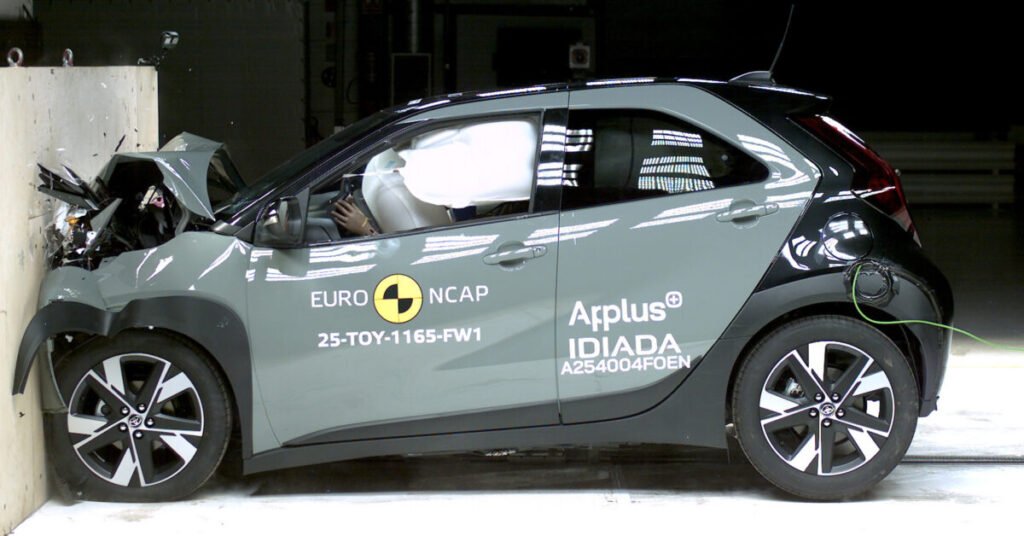
The way that cars are tested and rated for safety under the Euro NCAP (European New Car Assessment Programme) scheme is undergoing its biggest shake-up in more than 15 years, with the aim of making cars even safer.
Euro NCAP is an independent European road safety organisation, which conducts tests that go above and beyond the minimum legal requirements for a car to be sold in the UK or EU. It began crash-testing cars as far back as 1997, despite major opposition from the car industry, with the results of early tests highlighting serious inadequacies in some everyday family cars.
The now-familiar five-star rating system quickly became the industry standard for new-car safety, and car makers were equally quick to start promoting their five-star results. Over nearly 30 years, the tests have continuously evolved as technology has improved. Over the last decade, the emphasis has shifted from simply running cars into walls to assessing technologies that help avoid accidents in the first place. Tests also measure the level of harm to other road users, like pedestrians and cyclists.
The test protocols are reviewed every three years, usually resulting in tougher standards being set to achieve each star level. A car’s safety rating expires 6-7 years after it was tested, reflecting the continued drive for higher standards. If a car is still in production after its rating has expired, Euro NCAP may re-test it to see whether it maintains its original score or needs to be downgraded.
Most years, the organisation will test 50-60 new cars, usually the most widely sold models across Europe. Car companies will often provide brand-new cars for testing (which means they pay for the testing to take place), but Euro NCAP will often also buy cars to test off showroom floors – especially if a manufacturer is reluctant to provide cars for testing.
The Car Expert is one of only a few automotive sites that publishes the full Euro NCAP safety ratings – rather than just the headline star rating – as part of our unique Expert Rating report for new cars.
For 2026, Euro NCAP has comprehensively overhauled its testing programme to assess safety from a more holistic perspective. While physical crash testing is still a core part of the process, the organisation is looking at many other factors that can reduce fatalities and injuries on our roads.
The testing categories up until 2025
From 2009 to 2025, Euro NCAP tests have been made up of four categories:
- Adult Occupant – frontal impact, side impact and whiplash
- Child Occupant – rear seat and child seat safety
- Vulnerable Road Users – injury to pedestrians and cyclists
- Safety Assist – autonomous emergency braking, speed limit assistance, lane-keeping assistance, seatbelt warnings and driver fatigue detection
The four category scores combine to form an overall rating. Cars must achieve certain minimum scores in every category to be awarded an overall five-star rating. We have a separate feature that explains how the tests have worked for the last 17 years.
What’s changing for 2026?
Euro NCAP is keeping the system of four testing categories that combine to provide an overall five-star score. But the categories are changing to reflect four sequential stages of a car crash, rather than categorising by test type.
The four new categories under which each car is rated are called the ‘stages of safety’, which cover safe driving, avoiding an accident, protecting occupants and other road users in an accident, and safe extraction of occupants from a crashed car. It’s a new approach, although many of the previous tests will continue to be used. The new headings also bring in additional tests.
The assessment methods are very detailed (all the protocols are published here) so we’re taking a broad, high-level approach.
The new categories
From 2026, cars will be scored according to the new ‘stages of safety’, with the potential to earn up to five stars as before. Cars are judged on how they keep the driver alert, prevent crashes, protect occupants and road users and help the emergency services after a crash. They are:
- Safe Driving
- Crash Avoidance
- Crash protection
- Post-Crash

Safe Driving
This considers the vehicle technologies and features that help provide a safer driving experience for drivers and vehicle occupants. These are mostly covered by the term Advanced Driver Assistance Systems (ADAS), mandatory for cars sold in the EU and usually the same spec when they come to the UK. Assisted driving was first tested in 2020.
Although not mandatory, points have been awarded for Driver State Monitoring (DSM) since 2024, which measures how well a car’s built-in system detects distraction and drowsiness. This now gets further scrutiny for 2026.
Previously, steering wheel sensors were used to detect if a driver was drifting off to sleep or very unwell. Now, DSM systems must track the driver’s head and eyes to monitor for micro-sleep, sleep, and unresponsiveness, and then warn the driver. These systems must default to ‘on’ when the car is started and must require at least two button presses to be disabled.
Another timely new assessment is how distracting it is to adjust settings via a touchscreen rather than a physical button or knob. This looks at touch inputs onto a symbol, which is always present on the home screen, and a menu-based touch input taking a maximum of two steps. Certain commonly used functions must have dedicated physical controls to get a five-star rating (as a result, Tesla reintroduced physical indicator stalks to the Model 3 last year after previously removing them).
The DSM also looks for phone distraction – a specific type of short distraction event where the driver’s gaze is repeatedly drawn towards their mobile phone when it’s placed in a set space.
Speed assist systems have been assessed since 2013, but now verification of the accuracy of speed-limit information (some cars are hopeless at reading road signs) will be conducted during on-road driving tests.
Adaptive (or intelligent) cruise control systems also fall under ‘Safe Driving.’ In 2024, Euro NCAP gave a ‘Not Recommended’ grading to the BYD Atto 3’s intelligent cruise control because it failed to respond correctly when it was approaching other cars or motorcycles, and failed to take proper action when the driver was unresponsive. BYD provided a software update for existing cars, and the 2025 model-year Atto 3 received a ‘Good’ rating for assisted driving.
Vehicles able to detect whether seatbelts are being worn correctly and optimise restraint and airbag systems for different driver and passenger physiques will earn higher scores.
Lastly, in 2026, for the first time, impairment from alcohol or drugs was added, where an alcohol interlock system is fitted.
Crash Avoidance
The Crash Avoidance category examines systems that help prevent or mitigate a crash through warnings or interventions. These include blind-spot detection (including detection of motorbikes and cyclists) and Emergency Lane Keeping (ELK), which activates when a car has crossed the road and is in the path of an oncoming vehicle.
A common moan in new car road tests is lane keeping assistance systems (which NCAP calls Lane Keeping Assist) that are over-sensitive and yank the steering wheel violently when they mistakenly think the driver is drifting out of a lane, or cars which emit an excessive amount of beeps and bongs to warn you about this or exceeding speed limits.
Euro NCAP already puts cars on test tracks and makes them drift over varying types of white lines, but it now says that “smoothness and intuitiveness of operation in everyday driving, in particular for lane support systems, will now contribute to scoring, addressing consumer concerns about intrusive or unpredictable interventions.”
The tests have requirements for ‘Driver Acceptance’ of how the LKA acts, and notes that the sensitivity can be relaxed when the driver is classed as attentive with their eyes on the road.
There are new scenarios for motorbike avoidance and new ‘Low Speed Collision’ tests, which include a test on how well a car gives a warning if a door is opened into the path of an oncoming cyclist. Volvo, Ford and Volkswagen fit systems that can prevent the door being opened at all in such a situation.
Crash Protection
The Crash Protection category is what most people generally associate with safety testing – how well a car performs when it is fired into a wall, pole or barrier.
The tests evaluate the performance of traditional crash protection elements, including vehicle structure, seatbelts, airbags, and head restraints, to mitigate injuries to vehicle occupants, pedestrians, and cyclists.
Euro NCAP will continue to crash cars in various types of front and side impacts, but will now look for more detail in what happens to the occupants. From 2026, frontal crash testing will include the impact on a wider range of driver and passenger body types, from children (crash test dummies are already used to represent children six and ten years of age), to shorter and taller adults, plus older occupants, supported by sledge testing and virtual simulations. This will also address a concern that women have been less well represented by traditional crash testing than men.
Post-Crash Safety
This is a new category which addresses the ‘golden hour’ of emergency response after an accident, through post-crash rescue information and assistance systems built into the car. Much research over the years has shown that faster response times and extractions can dramatically improve a patient’s chance of survival after an accident, as well as reduce long-term or life-changing injuries.
Automated emergency call systems have been standard for all new cars sold in Europe since 2018. Dormant until a crash, these systems call emergency services and provide the car’s location, aiming to boost response times. For Euro NCAP, these systems will need to give information on how many people are known to be in the car, even if some are not wearing seatbelts, so authorities can send enough ambulances for all occupants.
There have been some media reports of cars with electric door handles failing to open after a crash, so Euro NCAP’s new post-crash requirements include ensuring that electrically powered exterior door handles remain operable after an impact.
Electric vehicles must allow the battery to be easily isolated by emergency services after a crash, communicate a battery fire risk to the driver after a crash, and issue a timely warning if a battery fire begins during charging or after a crash.
Do these new ratings make the old ones invalid?
No. Euro NCAP ratings are valid for 6-7 years after testing, so all cars tested since 2020 will retain their existing safety ratings until they expire. Cars tested in 2019 had their ratings expire in January this year, and ratings for cars tested in 2018 or earlier had already expired.
Because the testing protocols have changed so dramatically, scores for 2026 onwards are not directly comparable to those from 2025 or earlier. However, the principle of a car being a ‘four-star’ or ‘five-star’ car for safety remains.
If you’re looking at buying a used car, all test results back to 2016 are available on the Euro NCAP website.
Gaming the system?
Every time Euro NCAP updates its testing, it raises the bar for a five-star result higher. As a result, there’s usually a rush for manufacturers to get new cars tested (or existing cars re-tested) ahead of any major changes. With major new changes for 2026, there was a rush of car manufacturers submitting cars for testing last year.
Euro NCAP assessed some 107 cars in 2025 – about double its usual annual total – which included 61 cars just in the last three months of the year. Most of these recent tests were existing models that manufacturers put forward for reassessment, so they could be tested under the 2025 protocols rather than the new 2026 protocols.
With car manufacturers currently extending the production lives of many of their petrol and diesel cars, these models may be on sale for years to come. So the logic goes that it was better to foot the bill for re-testing the cars in 2025, even if they dropped a star, rather than have Euro NCAP decide to test the cars in 2026 or beyond when the score may be much lower.
Stuart Masson, editor
Read more: