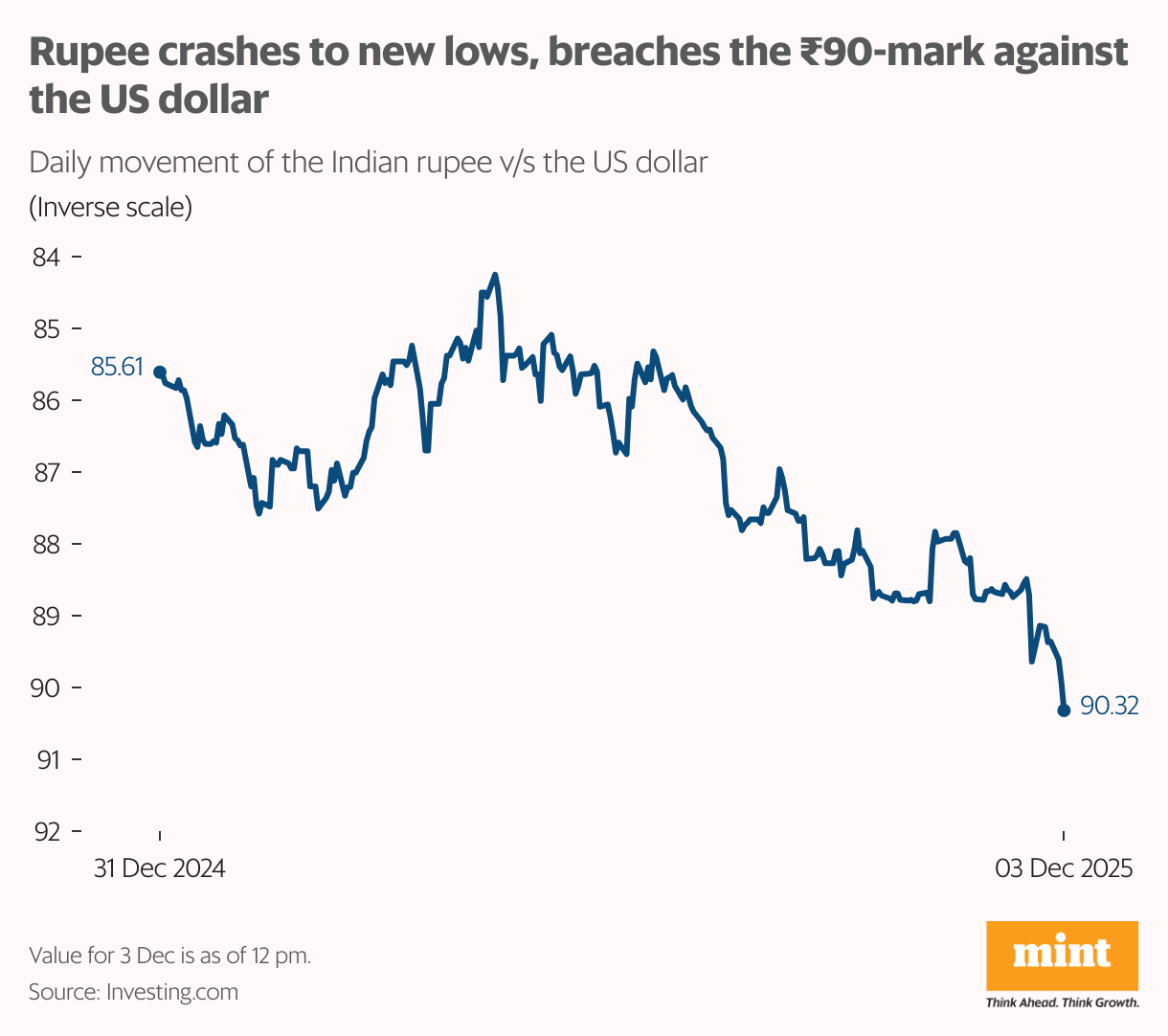
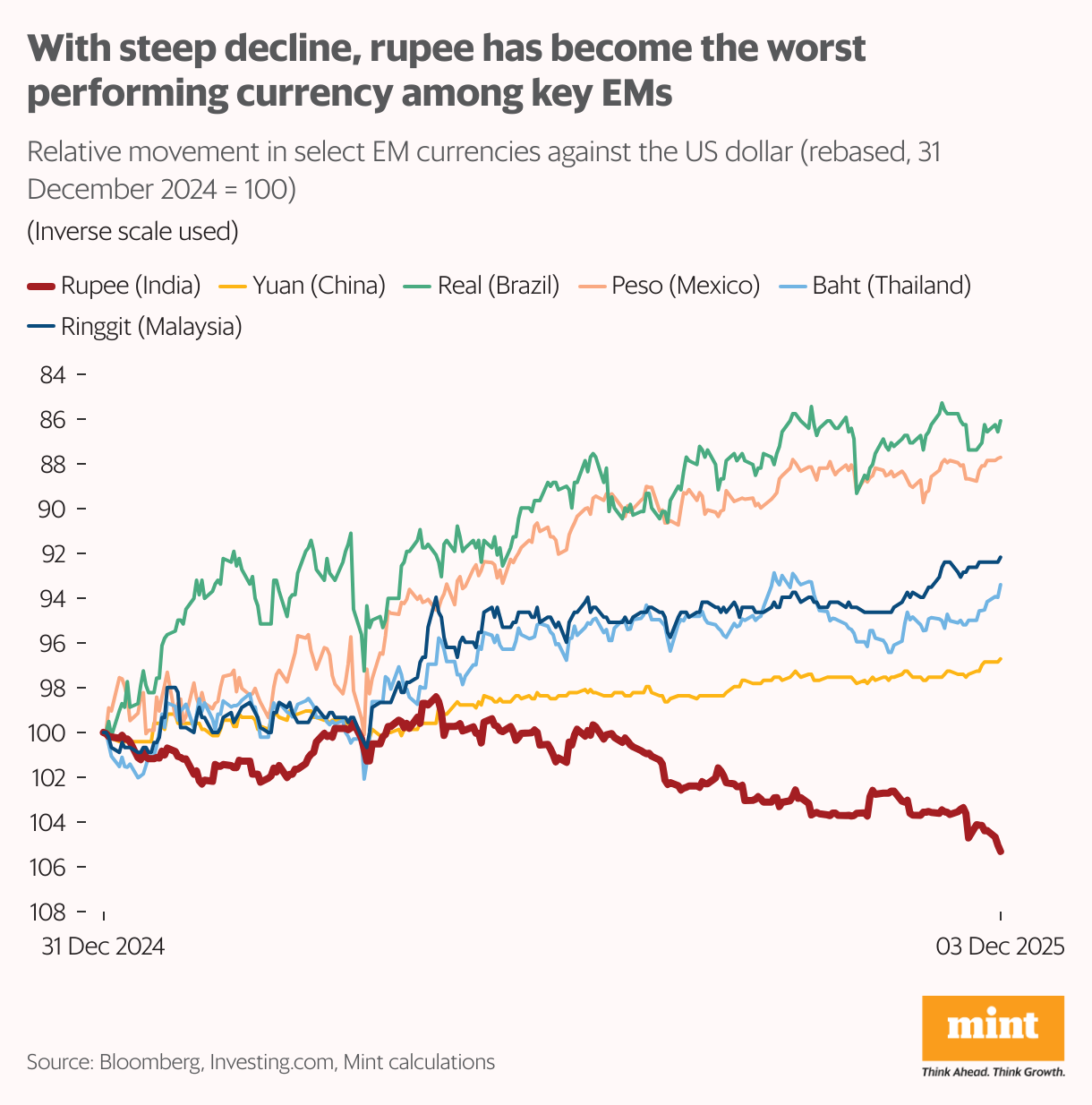
The rupee breached 90 to the US dollar on Wednesday, marking a new low for India’s currency, which has steadily weakened over the year and is now the worst performer among major emerging- and advanced-market currencies.
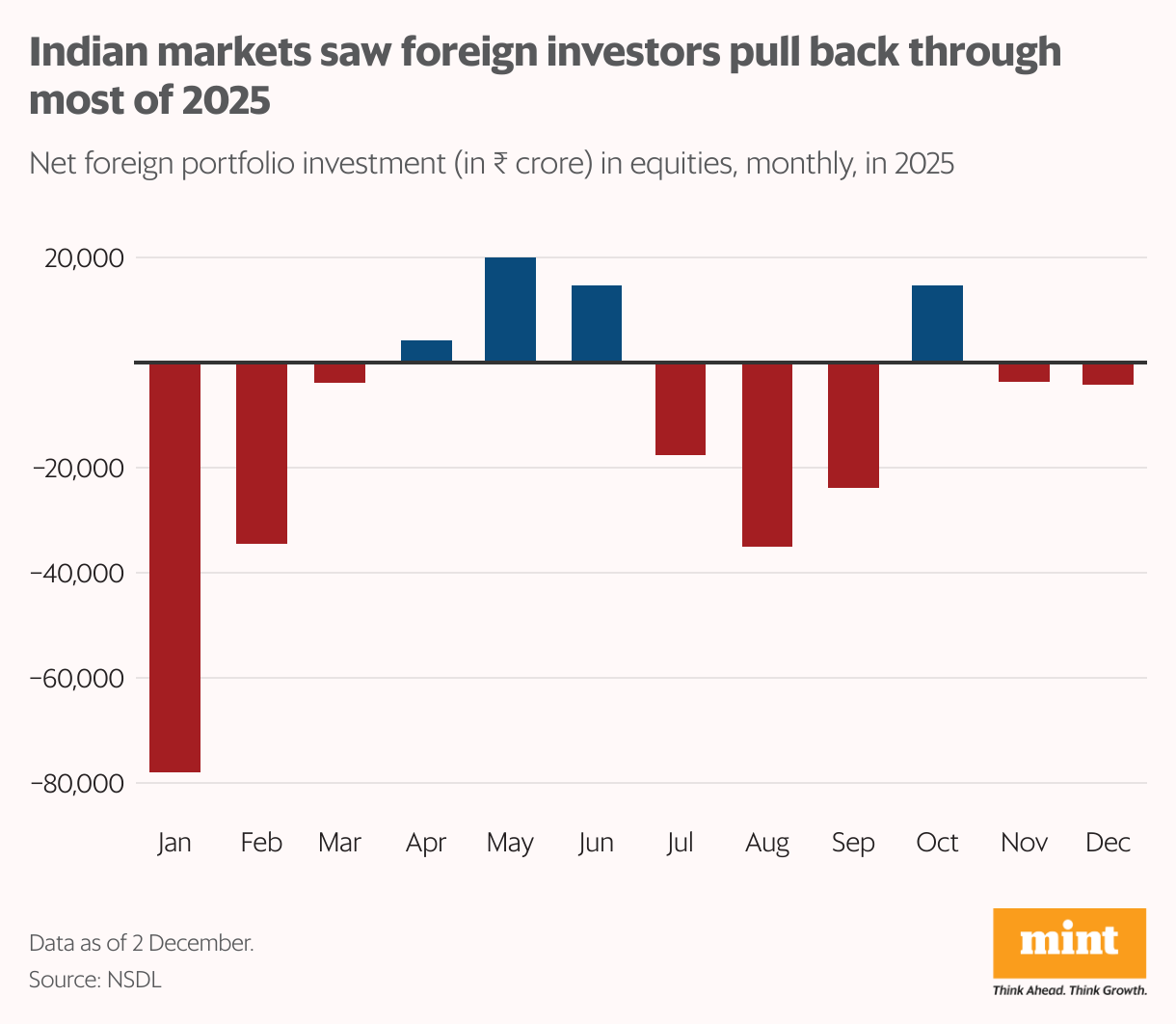
The rupee’s slide (it has fallen more than 5.5% this year as of 2 December) has been driven largely by a trade impasse with the US and continuing foreign portfolio investor (FPI) outflows from Indian markets.
It has been the worst-performing major currency this year, especially since the US slapped additional tariffs on India, leading to a 1.64% month-on-month depreciation against the dollar in August. The speed of its decline nearly halved to around 0.85% in September thanks to the Reserve Bank of India’s intervention, which helped reduce volatility. In November the rupee depreciated 0.5% against the dollar, behind the Indonesian rupiah, which depreciated 0.6%, and the Philippine peso, which fell 0.9%.
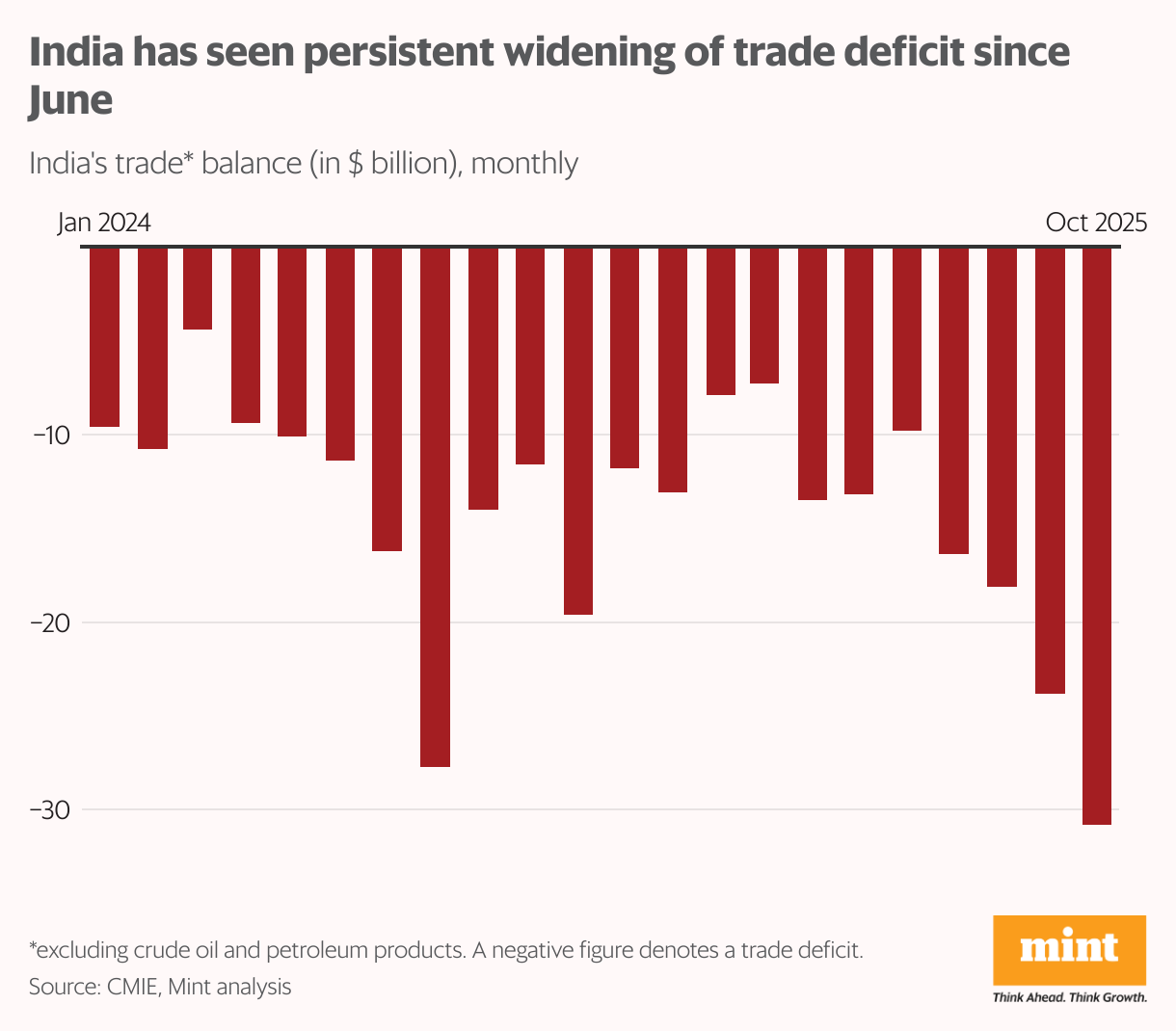
India’s widening trade deficit has increased the pressure on the rupee. Imports have remained strong, but exports have been hit by higher tariffs and global demand uncertainty, which has pushed up demand for the dollar.
Experts said the RBI—which was staunchly defending the rupee at certain levels until a month ago—was now allowing it to fall. “The RBI is smoothening moves but not defending levels,” said Dhiraj Nim, an economist and forex strategist at ANZ Bank. “This shows they recognise the need for a more competitive rupee until the trade deal is resolved.” He described the recent fall as a “natural economic adjustment” to the risks ahead.
Foreign investors have also been pulling money out of India for most of the year, reflecting concerns about the country’s growth outlook in a high-tariff environment.
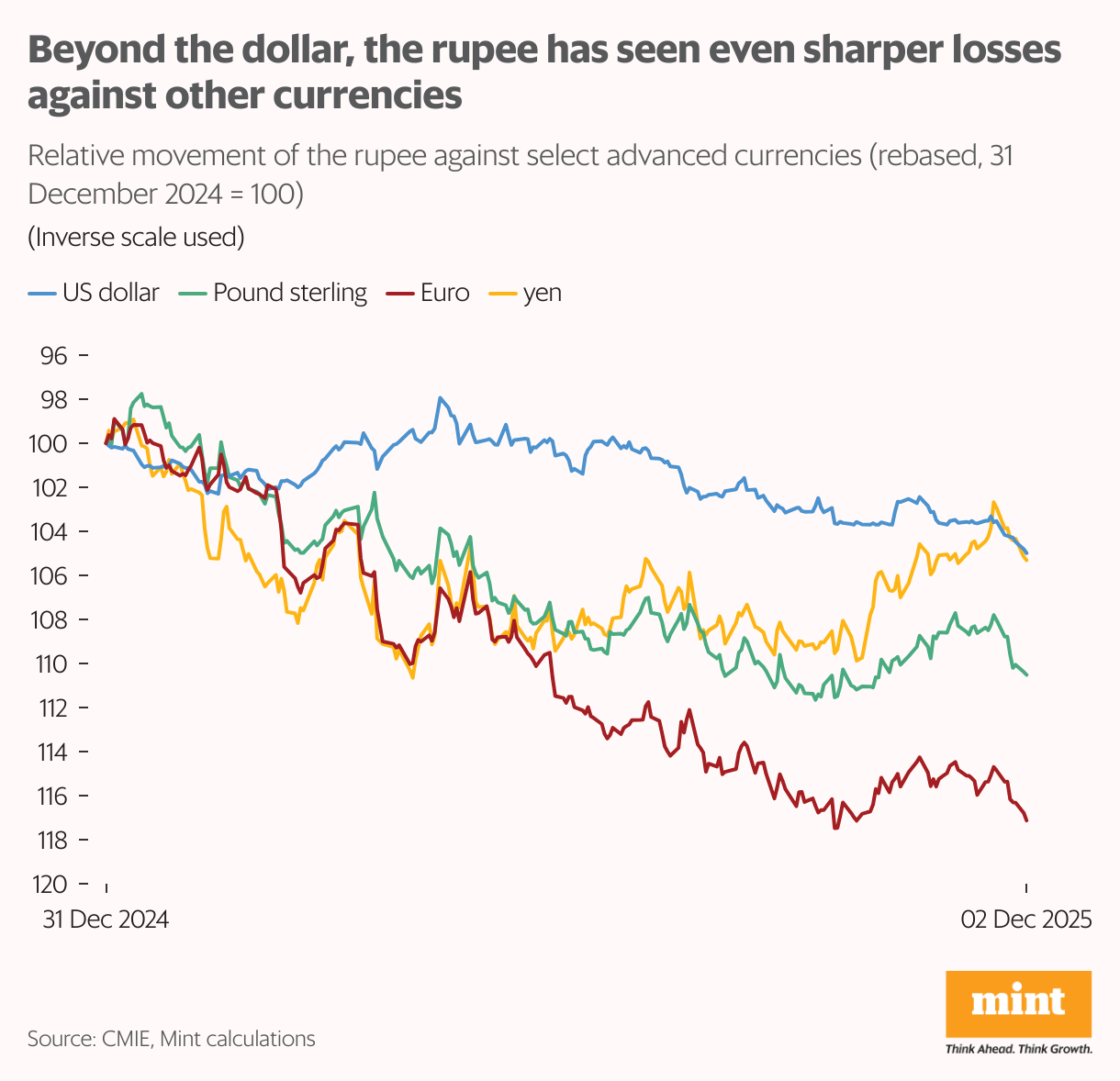
The rupee’s depreciation is not limited to the US dollar. It has also slipped against the euro, pound and yen, signalling a broader reassessment of India’s external resilience rather than a dollar-specific move.
ANZ’s Nim said he expected the rupee at 91.5 by the end of FY27, though he noted that “with the current momentum, that level can be realised sooner” if there’s no clarity soon on the India-US trade agreement.
Other experts echoed this view. “If a trade deal between the US and India to lower tariffs is not reached, the bias would tilt towards further INR weakness and more RBI rate cuts, even as India’s domestic economy should continue to cushion India’s overall GDP,” analysts at MUFG wrote in a report dated 2 December.