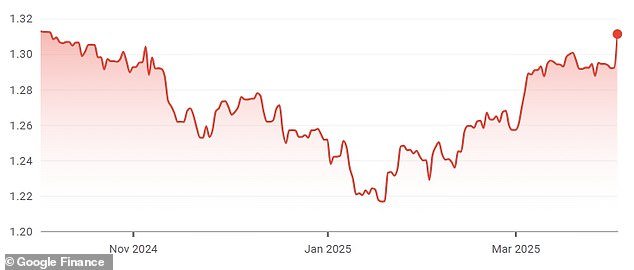
GBP/USD soured on Monday, starting off the December trading window declining around one-quarter of one percent, pushing back down from a key technical confluence region that will likely inspire further short selling behind the Pound Sterling (GBP) unless global flows into the US Dollar (USD) reverse course.
Pound struggles under the weight of political troubles
Chancellor of the Exchequer Rachel Reeves has come under fresh fire regarding the state of the UK’s government budget. Chancellor Reeves stands accused of grossly misreprenting the true state of the UK’s finances. Chancellor Reeves has continued to advocate for “unavoidable increases” in budgetary taxes, despite the Office for Budget Responsibility (OBR) noting recently that the current government is facing an unexpected surplus, rather than the forecast deficit, thanks to stronger-than-expected wage growth and higher-than-expected tax revenues offsetting declines in productivity.
Prime Minister Kier Starmer’s wobbly government in British Parliament continues to face political headwinds on all fronts, with polling numbers declining steadily and support from within Starmer’s own Labour party dwindling. Political instability is beginning to underpin market flows into (but mostly out of) the Pound Sterling, limiting topside potential for bullish Cable hopefuls.
Fed rate cut odds remain the focal point
The possibility of a December interest rate cut from the Federal Reserve (Fed) remains the key focal point for global markets, and US Dollar traders in particular. Official data remains limited following the longest US government funding closure in history, and the Fed is facing down a notable lack of meaningful labor and inflation metrics heading into its rate call on December 10. ADP Employment Change figures are due on Wednesday, and are expected to show another downturn in new hiring. With a lack of large-scale Nonfarm Payrolls (NFP) figures for both October and November, the Fed is faced with the difficult choice of cutting interest rates based on volatile private sector data, or holding off for another month or two while policymakers wait for a jumpstart in data collection and reporting to push fresh economic data to the forefront.
Federal Reserve (Fed) interest rate cut expectations are spreading into a messy pool heading into the tail end of the year. Rate markets are still pricing in nearly 90% odds of a third straight interest rate cut on December 10. However, rate traders are also pricing in 88% odds that the Fed will hold off in December and deliver a quarter-point rate trim in January.

GBP/USD price forecast
GBP/USD price action found a hard wall at the 1.3250 level on Monday, rejecting intraday bids and sending the Cable pair back toward the 1.3200 neighborhood. Converging 50-day and 200-day Exponential Moving Averages (EMA) at the 1.3250 region adds significant downward pressure to the chart zone, and a slow Stochastic Oscillator (14,5,5) testing the high side of overbought conditions is teasing that further downside momentum could be on the cards.
GBP/USD daily chart

Pound Sterling FAQs
The Pound Sterling (GBP) is the oldest currency in the world (886 AD) and the official currency of the United Kingdom. It is the fourth most traded unit for foreign exchange (FX) in the world, accounting for 12% of all transactions, averaging $630 billion a day, according to 2022 data.
Its key trading pairs are GBP/USD, also known as ‘Cable’, which accounts for 11% of FX, GBP/JPY, or the ‘Dragon’ as it is known by traders (3%), and EUR/GBP (2%). The Pound Sterling is issued by the Bank of England (BoE).
The single most important factor influencing the value of the Pound Sterling is monetary policy decided by the Bank of England. The BoE bases its decisions on whether it has achieved its primary goal of “price stability” – a steady inflation rate of around 2%. Its primary tool for achieving this is the adjustment of interest rates.
When inflation is too high, the BoE will try to rein it in by raising interest rates, making it more expensive for people and businesses to access credit. This is generally positive for GBP, as higher interest rates make the UK a more attractive place for global investors to park their money.
When inflation falls too low it is a sign economic growth is slowing. In this scenario, the BoE will consider lowering interest rates to cheapen credit so businesses will borrow more to invest in growth-generating projects.
Data releases gauge the health of the economy and can impact the value of the Pound Sterling. Indicators such as GDP, Manufacturing and Services PMIs, and employment can all influence the direction of the GBP.
A strong economy is good for Sterling. Not only does it attract more foreign investment but it may encourage the BoE to put up interest rates, which will directly strengthen GBP. Otherwise, if economic data is weak, the Pound Sterling is likely to fall.
Another significant data release for the Pound Sterling is the Trade Balance. This indicator measures the difference between what a country earns from its exports and what it spends on imports over a given period.
If a country produces highly sought-after exports, its currency will benefit purely from the extra demand created from foreign buyers seeking to purchase these goods. Therefore, a positive net Trade Balance strengthens a currency and vice versa for a negative balance.