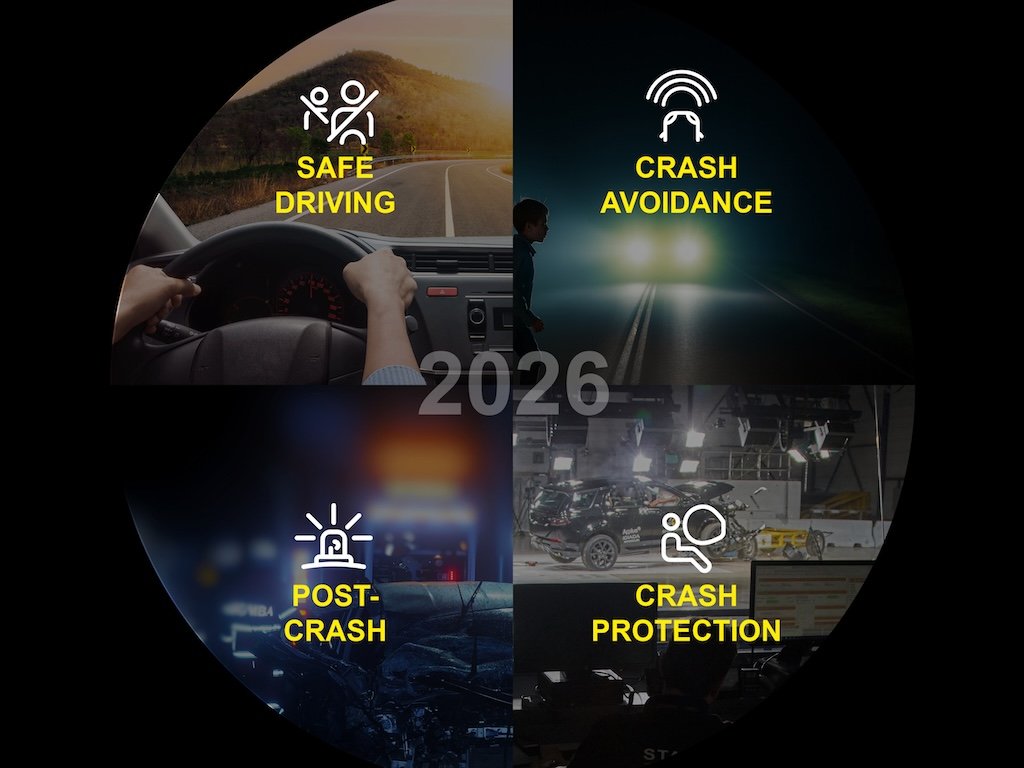
Euro NCAP is overhauling its testing and scoring procedures to clamp down on “annoying” driver assistance systems and to ensure crash-prevention systems are designed for real-world environments.

The new rating methodology will centre around four key stages of safety
The major update – the largest revision since the introduction of the overall rating system in 2009 – will go into effect in 2026 and is intended to improve protection for vehicle occupants and all road users.
The new rating methodology will centre around four key stages of safety – safe driving, crash avoidance, crash protection and post-crash safety – drawing on the principles of the Haddon Matrix. Each of these will be scored out of 100 points and expressed as a percentage. Minimum thresholds will continue to apply for each stage and will determine the overall star rating.
Prominent overhauls include changes for advanced driver assistance systems (ADAS). Such technology has come under criticism for annoying warnings or intrusive interventions – as spotlighted by the UK’s Association of Fleet Professionals (AFP) – and will now be evaluated not only on crash-prevention abilities on the test track, but also during real-world driving, with the aim of improving consumer acceptance.
The emphasis will now be on driver monitoring technologies that maintain attention and engagement behind the wheel, focusing on improved system reliability and user acceptance. Points will be awarded for advanced systems that monitor driver performance in real time.
Additional credit will be given to technologies that can identify signs of drug or alcohol impairment and those capable of safely bringing the vehicle to a halt if the driver becomes unresponsive.
New assessments will evaluate the placement, clarity and ease of use of essential controls – including the availability of physical buttons for commonly used functions, following rising concerns that touchscreen controls can increase distraction.
Euro NCAP is also introducing new, expanded test scenarios to improve the robustness of crash-prevention systems, particularly in conditions that are more representative of real-world environments.
Crash-protection evaluations will expand to include a broader spectrum of occupant body sizes, from children to shorter and taller adults, using full-scale crash tests, laboratory sled tests and advanced virtual simulations. The vehicle testing body said this would enhance accuracy and promote more adaptive restraint systems.
Meanwhile, new post-crash requirements will require electrically powered exterior door handles to stay functional for easier rescue – countering the trend for ‘vanishing’ flush handles and following concerns over power failure vulnerabilities that could impede emergency rescue and escape.
The ratings will also mandate proper high-voltage battery isolation in electric vehicles, among other updates to help first responders.
And automated emergency notifications will need to provide details on the number of occupants in the vehicle, requiring reliable detection even when seatbelts are not fastened. These changes aim to support faster, more accurate emergency response following a collision.
There’ll also be higher scores for vehicles able to detect whether seatbelts are being worn correctly – and optimise restraint and airbag systems for different driver and passenger physiques.
For the first time, verification of speed-limit information accuracy will be conducted during on-road driving tests.
Euro NCAP secretary general Michiel van Ratingen said the updated protocols would “further strengthen the rigour and relevance of our tests, rewarding vehicles that perform well across all stages of safety – before, during and after a crash”.
He added: “The intended outcome is improved protection for vehicle occupants and all road users through more effective driver assistance, robust accident prevention, enhanced crash protection and improved post-crash management.”
Eight out of 10 dealers say drivers are put off by used cars equipped with ADAS
Euro NCAP’s plans to improve consumer acceptance of driver assistance features come as new research reveals eight out of 10 used car dealers (80%) say buyers are put off by newer used cars equipped with ADAS.
The study by Startline Motor Finance shows 55% believe motorists are unconvinced of the recently introduced safety benefits, 20% that some opt instead for slightly older models with fewer ADAS features and 18% that buyers find them actively annoying.
Paul Burgess, CEO at Startline Motor Finance, said: “New EU regulations mandated a whole host of ADAS devices from July last year and UK cars tend to be made to the same specifications, partially in the expectation that our government will follow suit.
“While some ADAS devices, such as emergency braking, have been found on UK cars for some time, the new introductions do tend to be intrusive, such as audible warnings if you exceed the speed limit and lane departure that will take control of the steering wheel.
“Much research has gone into these devices and road safety experts believe they will have a marked effect on accident rates. However, there is little question some drivers find them annoying and the vast majority of dealers think this is having a direct impact on the saleability of the cars involved.”
However, the research also shows that none of the dealers surveyed think consumers will tend to turn off ADAS features on cars they have bought.
Burgess said: “This is an interesting finding which has two potential explanations, we believe. One is the option to turn off the devices tends to be buried in a submenu and they reset to ‘on’ every time the car is started anyway. The second is the possibility that drivers will just become accustomed to ADAS over time and perhaps start to perceive the advantages.
“It is interesting that 55% of dealers think motorists are unconvinced of the safety benefits. Perhaps some form of education campaign is needed to show how cars equipped in this way will actively prevent accidents.”