What Is a Forward Premium?
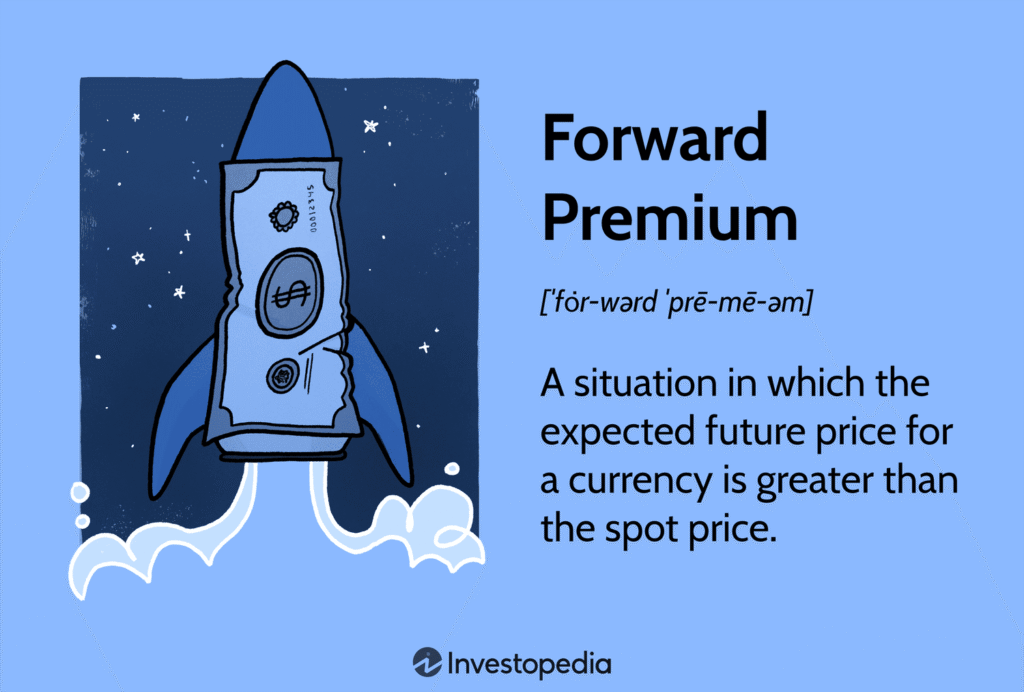
A forward premium occurs when a currency’s forward rate exceeds its current spot rate, signaling market expectations that the currency will weaken relative to another. This reflects anticipated shifts in exchange rates influenced by factors such as interest rate differentials, inflation, and economic stability.
Forward premiums play a central role in international trade and investment decisions, helping businesses hedge against potential currency fluctuations and manage exchange rate risk.
Key Takeaways
- A forward premium occurs when the forward rate of a currency is higher than its spot rate.
- Forward premiums and discounts are influenced by interest rate differentials, inflation, speculative trading, and economic stability.
- International businesses and traders monitor forward premiums to inform financial decisions and manage currency exposure.
- The forward premium calculation considers both the current spot price and interest rates in the involved countries.
- A forward premium can signal expectations of a currency’s future appreciation, affecting international financial planning.
How Forward Premiums Work
A forward premium is measured as the difference between the current spot rate and the forward rate, so it is reasonable to assume that the future spot rate will be equal to the current futures rate.
According to the forward expectation theory of exchange rates, the current spot futures rate will be the future spot rate. This theory is rooted in empirical studies and is a reasonable assumption over a long-term time horizon.
Forward currency exchange rates usually differ from spot rates. A premium occurs if the forward rate is higher, while a discount exists if it’s lower.
Important
Typically, a forward premium reflects possible changes arising from differences in the interest rate between the two currencies of the countries involved.
Calculating Forward Premiums: A Guide
The calculation of a forward rate requires both the current spot price of the currency pair and the interest rates in the two countries:
Forward Premium/Discount (as a Percentage) = (Forward Rate – Spot Rate) ÷ Spot Rate x 100
Consider this example of an exchange between the Japanese yen and the U.S. dollar:
- The ninety-day yen to dollar (¥ / $) forward exchange rate is 109.50.
- The spot ¥ / $ rate is = 109.38.
- For an annualized forward premium: ((109.50-109.38) ÷ 109.38) x (360 ÷ 90) x 100% = 0.44%
Here, the dollar is stronger than the yen because its future value surpasses the spot value by 0.12 yen per dollar. The yen trades at a discount since its forward value is less than its spot rate.
To calculate the forward discount for the yen, you first need to calculate the forward and spot exchange rates for the yen in the relationship of dollars per yen.
- ¥ / $ forward exchange rate is (1÷109.50 = 0.0091324).
- ¥ / $ spot rate is (1÷109.38 = 0.0091424).
- Annualized forward discount for the yen, in terms of dollars = ((0.0091324 – 0.0091424) ÷ 0.0091424) × (360 ÷ 90) × 100% = -0.44%
Calculating Forward Rates for Different Time Periods
To calculate for periods other than a year, one needs to input the number of days as shown in the following calculation:
Forward Rate = Spot Rate × (1 + Interest Rate of Currency A)T / (1 + Interest Rate of Currency B)T
where Currency A is the base currency, Currency B is the quote currency, and T is the time period.
So, a three-month forward rate is equal to the spot rate multiplied by (1 + the domestic rate x 90/360 / 1 + foreign rate x 90/360).
As an example, assume the current U.S. dollar-to-euro exchange rate is $1.1365. The domestic interest rate, or U.S. interest rate, is 5%, and the foreign interest rate is 4.75%.
Forward Rate = $1.1365 x (1.05 / 1.0475) = $1.1392
In this case, the result reflects a forward premium.
What Does the Forward Premium Mean?
The forward premium reflects an interest in a particular currency that’s driven by a variety of factors, including interest rates. A higher interest rate in one country relative to another can make its currency attractive for those who want to benefit from the higher rate.
Why Does a Forward Premium Matter?
A forward premium can indicate that the market expects a currency to grow in value in the future. For businesses operating internationally, as well as currency speculators, this can be useful information. If there’s a forward premium, a business may want to use a forward contract to lock in an attractive exchange rate for future transactions. If there’s a forward discount, it may want to avoid any currency purchases until rates look more favorable for its purposes.
What Are the Factors That Can Affect Forward Premium?
Interest rate differentials between countries, inflation rates, speculative trading activity, and the state of a country’s economic stability can influence forward premium. That means that a forward premium can change, depending on the impact of these factors.
The Bottom Line
A forward premium occurs when a currency’s forward rate is higher than its current spot rate, signaling expectations of appreciation, while a forward discount indicates anticipated depreciation. For international businesses, understanding these movements is important for managing currency exposure and timing transactions effectively.
Factors such as interest rate differentials, inflation, and economic stability drive forward premiums and discounts, which are often used in forward contracts to hedge against exchange rate risk.