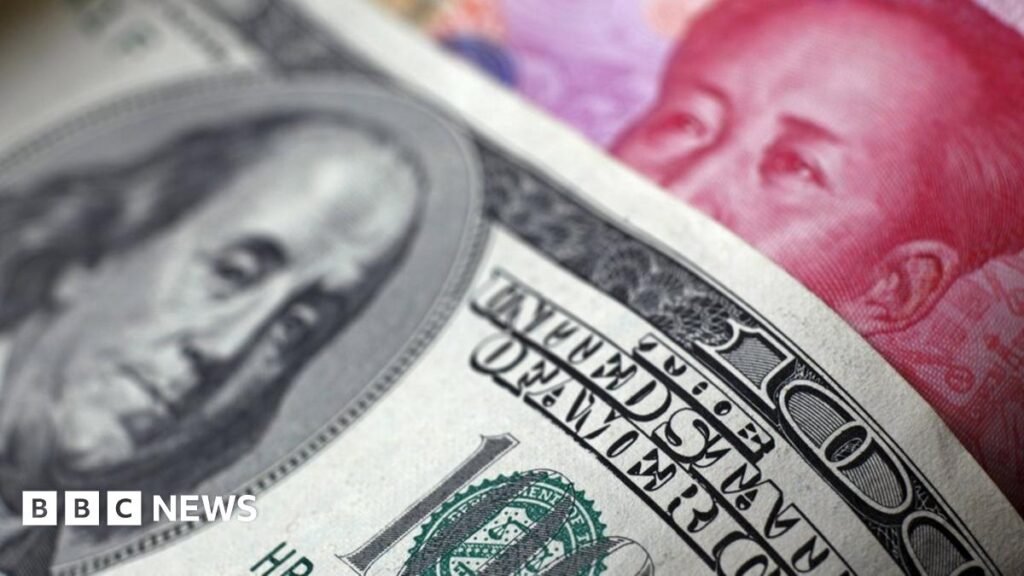
This Friday, the yuan hit a six-year low having done so again and again over the past few weeks, which you can see from the dollar climbing all the way up at the end of the graph.
And over the past year the Chinese currency has been weakening against the US dollar in small but significant ways.
That’s a “managed devaluation” of about 4%, says Vinesh Motwani of Silk Road Research.
But take note of when this all started to really take-off.
The G7 meeting in Japan – when currency manipulation was very much the hot topic – was in May.
At that time, China was under pressure to show that it wasn’t unduly influencing the direction of its currency. In particular it had to convince the US and Japan. So if you look at the chart, it doesn’t show a big dip at that point. But then the dollar does begin to gradually strengthen.
Now look at the chart again, this time in September, when China hosted the G20 summit. Again – a slight dip. But then soon after, more appreciation of the US dollar against the yuan.
“The G20 was a significant marker for the government,” says Mr Motwani. “They needed to send the impression and perception of stability in China, and one of the most visible metrics, is a stable currency.”
What appears to be happening is what Mr Motwani calls the government’s desire for the yuan to have an “orderly depreciation of around 3% to 5% against the US dollar”.